
Starting a pasta manufacturing business requires the right machinery, production planning and investment strategy. For entrepreneurs and small food processing companies, a semi-automatic pasta making machine can be a practical option for beginning commercial production without investing in a fully automated manufacturing plant.
With increasing demand for macaroni, penne, fusilli, spaghetti and other pasta varieties, small manufacturers have opportunities to serve local retailers, restaurants, hotels, supermarkets and packaged food distributors.
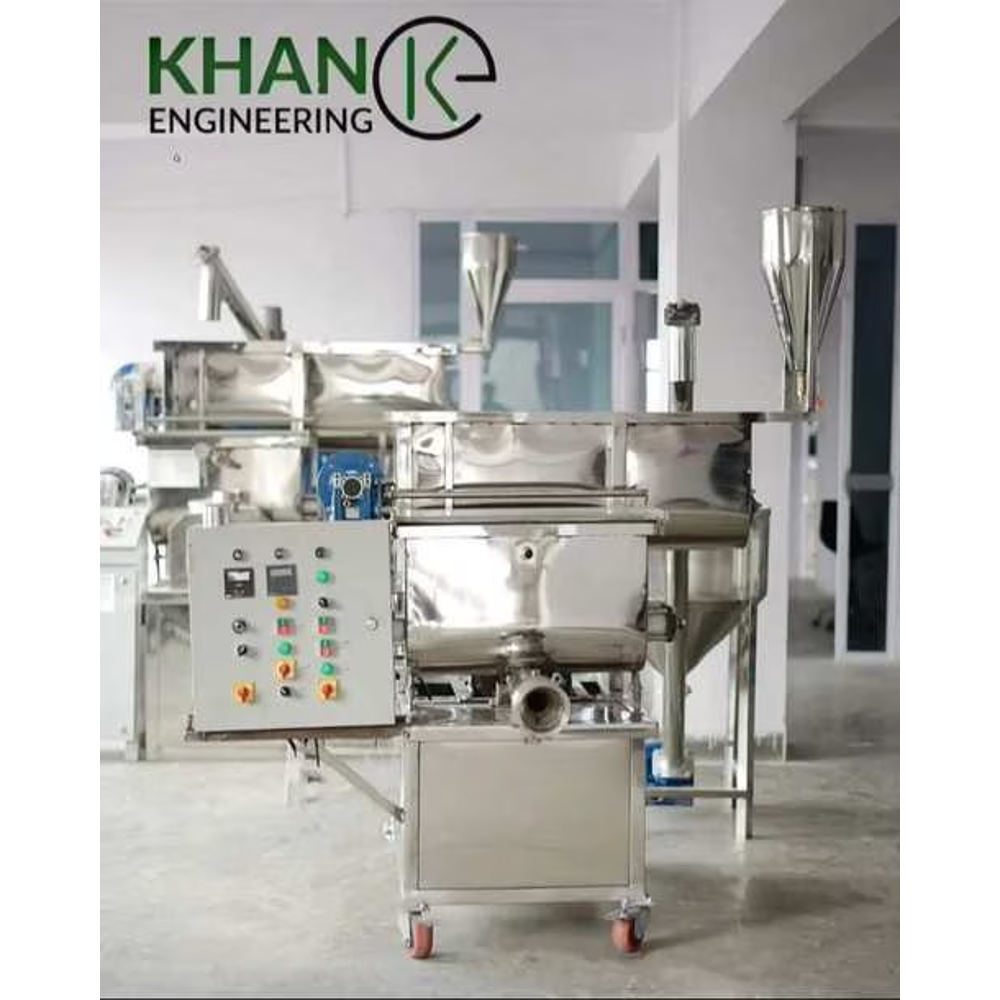
Khan Engineering offers pasta manufacturing machinery solutions for different production requirements. A semi-automatic pasta making machine helps small businesses process prepared dough into different pasta shapes with operator-assisted production and suitable extrusion technology.
What Is a Semi-Automatic Pasta Making Machine?
A semi-automatic pasta making machine is an industrial food processing machine designed to manufacture pasta products with a combination of automated mechanical operations and manual operator involvement.
The machine generally uses an extrusion system to shape prepared pasta dough through specially designed dies. Depending on the machine configuration, operators may handle dough preparation, material feeding, cutting, product collection and other production activities.
This type of machinery is suitable for businesses looking to establish a small or medium-scale pasta manufacturing operation with a manageable production setup.
Why Is a Semi-Automatic Pasta Machine Suitable for Small Businesses?
Small food manufacturing businesses often need machinery that balances production requirements, investment costs and operational flexibility.
A semi-automatic pasta machine can help entrepreneurs begin commercial manufacturing with a comparatively straightforward production arrangement. It can also provide flexibility for businesses that want to test different pasta products before expanding their production capacity.
Manufacturers can plan production according to customer demand and gradually increase their machinery requirements as their business grows.
What Types of Pasta Can Be Produced?
Depending on the machine design and available extrusion dies, a suitable semi-automatic pasta making machine can manufacture multiple pasta varieties.
Macaroni: Tubular pasta products commonly used in packaged food markets, restaurants and household cooking.
Penne: Short, tube-shaped pasta with angled ends, widely used in commercial food preparation.
Fusilli: Spiral-shaped pasta produced using specially designed extrusion dies.
Spaghetti: Long, thin pasta strands requiring suitable extrusion and handling arrangements.
Other Pasta Shapes: Additional shapes may be possible depending on die compatibility, machine configuration and processing requirements.
Before purchasing, manufacturers should confirm which pasta shapes can be produced using the selected machine.
How Does a Semi-Automatic Pasta Making Machine Work?
The manufacturing process begins with preparing pasta dough using suitable flour, water and other recipe ingredients.
The prepared dough is transferred to the machine's feeding system and processed through the extrusion chamber. The dough passes through a specially designed die that determines the final pasta shape.
The extruded pasta is then cut or collected according to the required product dimensions. Depending on the production arrangement, the pasta may undergo additional drying to achieve the desired moisture level and storage stability.
After processing, the finished pasta is inspected, weighed and packed for commercial distribution.
Important Features to Consider Before Buying a Semi-Automatic Pasta Machine
Production Capacity: Select a machine according to your expected hourly and daily production requirements.
Interchangeable Dies: Check whether the machine supports different dies for producing macaroni, penne, fusilli and other pasta shapes.
Food-Grade Construction: Food-contact components should be made from suitable food-grade materials and designed for hygienic processing.
Ease of Operation: Simple operating arrangements can help small businesses manage daily production more efficiently.
Maintenance Requirements: Evaluate cleaning procedures, spare parts availability and accessibility of machine components.
Drying Compatibility: Consider whether a separate pasta drying system is required to achieve the desired finished-product quality.
Semi-Automatic vs Fully Automatic Pasta Making Machine
Both machine types serve commercial pasta manufacturing requirements, but their automation levels and operational arrangements differ.
A semi-automatic pasta machine involves operator participation in certain production stages. It can be suitable for startups and small manufacturers that want a flexible production arrangement.
A fully automatic pasta production line integrates more processing operations and is generally pre