
A gold finger making machine may refer to electronics equipment for plated PCB contacts or to a snack-forming machine, so comparing it with pasta, noodle or frying equipment without defining the product can produce the wrong quotation. By the end, you will be able to identify the correct process route, compare saleable output and operating demands, and structure a supplier trial that tests the complete production line.
Key takeaways
- Gold finger equipment plates PCB contacts; it does not make food products.
- Match forming equipment to the product’s dough, shape, filling and cooking method.
- Compare usable output, changeover time, rejects, utilities and labour—not only kg/hr.
- Demand a product trial, acceptance criteria and measured production records before purchase.
What does “gold finger” mean, and why does the category matter?
A gold finger in electronics is a plated edge contact on a printed circuit board, not a food shape. Its finishing line includes PCB edge preparation, masking, nickel underplating, hard-gold electroplating, cleaning and inspection; that equipment cannot produce pasta, noodles or snacks.
“Gold finger” is also a market name for a finger-shaped fried snack, but it is not a universally defined food or machine category. A gold finger making machine might mean only a former, or an entire line with frying and packing.
A search combining electronic gold fingers with automated food production can return irrelevant machinery, inaccurate specifications and unsuitable safety or sanitation assumptions.
Before comparing a gold finger machine versus alternative food production equipment, define:
- Raw material and dough moisture
- Cross-section and target piece length
- Bulk density and finished texture
- Frying method and target final moisture
| Term | Actual equipment context | What to confirm |
|---|---|---|
| Electronic gold finger | PCB edge-finishing line | Plating, cleaning and inspection specifications |
| Fried gold-finger snack | Forming, cutting, frying, de-oiling and seasoning line | Shape, moisture, texture and throughput |
| Pasta or noodle product | Extruder, sheeter, cutter, steamer or dryer | Dense, rehydratable product requirements |
Without these details, suppliers can quote different forming principles and downstream equipment under the same name.
Which forming process matches the snack, pasta or noodle product?
Choose the forming family by dough behaviour and finished texture, not by the nickname “gold finger.” A cooked or partly cooked starch dough needing a continuous finger-like, ridged, hollow or expanded profile suits direct extrusion; sheeting, slitting and cutting produce flatter, more uniform ribbons and cannot replace that extruder.
| Option | Process route | When it applies |
|---|---|---|
| Pasta extruder | Dough development, extrusion, cutting, drying | Dense, rehydratable pasta shapes |
| Noodle line | Mixing, sheeting or extrusion, cutting, steaming, drying | Elastic strands requiring rehydration |
| Sheeter and cutter | Roll reduction, slitting, length cutting | Flat snacks, strips or ribbons |
| Puff-snack system | Starch conditioning, extrusion, expansion, frying or hot-air treatment | Light, expanded products |
| Batch fryer | Portion loading, timed frying, unloading | Lower volume or varied recipes |
| Continuous fryer | Metered feed, controlled belt residence, de-oiling | Standardized, high-volume snacks |
A conventional fried finger-shaped snack route may run from ingredient mixing through extrusion or forming, cutting, frying, de-oiling, seasoning and packaging. A gold finger snack machine comparison is incomplete if its quoted kilograms per hour cover only dough input rather than saleable fried pieces.
Check these product specifications before selecting an automated food production machine:
- Raw material, formulation, moisture and target cross-section
- Piece length, bulk density, expansion ratio and final texture
- Frying method, throughput, changeover time and available floor space
- Finished moisture, acceptable breakage, seasoning load and pack size
Select the pasta extruder or noodle line for dense products, and the puff-snack system with a batch or continuous fryer for expanded snacks. A sheeter and cutter is appropriate only when its flatter geometry matches the product.
How should you compare a gold finger snack line beyond its kg/hr claim?
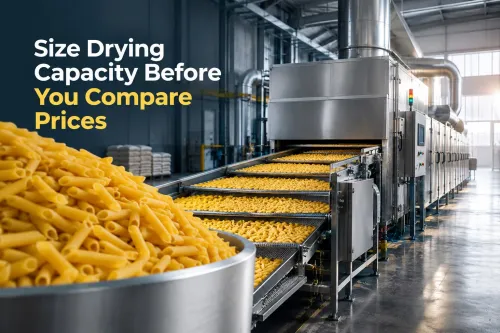
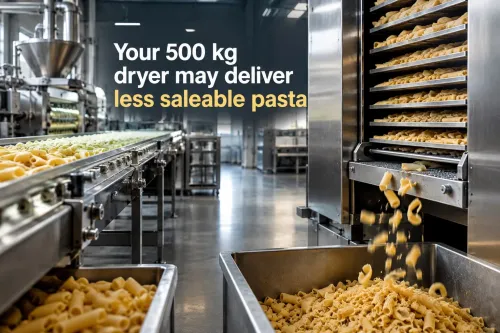
A quoted 500 kg/hr proves little until you identify what the kilograms represent: dough input, wet product before frying, product before drying, or finished product after frying and cooling. A useful gold finger snack machine comparison separates nameplate capacity from saleable output and measures the result from your recipe.
| Measure | Ask the supplier to record | Why it matters |
|---|---|---|
| Finished output | Pieces per hour, yield loss, start-up scrap and breakage | Reveals saleable capacity |
| Product conformity | Percentage within specified length, color and final moisture | Exposes inconsistent forming and frying |
| Availability | Usable production time, changeover duration and cleaning time | Shows daily output after stoppages |
| Utilities | Fryer oil capacity, oil consumption and energy use | Quantifies operating cost |
| Downstream quality | Residual surface oil, seasoning adhesion and product condition after the intended holding period | Prevents greasy packs and seasoning loss |
Continuous frying suits standardized, high-volume production because residence time, belt speed and oil temperature remain controlled. Batch frying can reduce capital commitment and handle varied recipes, but it needs more operator intervention and produces greater batch-to-batch variation.
Test frying temperature and residence time with different thicknesses, feed moisture, oil types, loading rates and target final moisture; the product name does not determine either setting. Treat de-oiling and seasoning as separate stages in the trial. Seasoning performance depends on residual oil, product temperature, tumbler residence time, powder particle size and feed rate.
An automated food production machine earns its capacity claim only when those measurements meet your specification.
What belongs in a complete automated food production machine?
A complete automated food production machine is a coordinated line, not a standalone extruder, fryer or packer. Map the route from mixing through forming or extrusion, cutting, drying or frying, cooling, conveying, weighing, metal detection, seasoning and packaging. Confirm whether utilities, exhaust, wastewater, fire protection and building modifications are excluded.
| Option | Staffing | Consistency and flexibility | Capital, cleaning and space |
|---|---|---|---|
| Fully automatic | Few operators for monitoring and replenishment | Highest repeatability; recipe changes require controlled changeovers | Highest capital; less routine handling but needs coordinated floor space |
| Semi-automatic | Operators transfer product or load stages | Good consistency with more product flexibility | Medium capital; moderate cleaning labour and space |
| Batch setup | More operators measure, load and unload each batch | Flexible for varied recipes; greater batch variation | Lowest entry capital; highest handling and cleaning labour, with smaller modular footprints |
Require recipe control, interlocks, alarms and traceable records for feed rate, fryer temperature, belt speed, oil level, seasoning rate and packaging faults. A PLC and touchscreen alone do not prove process control.
Check product-contact materials, sanitary welds, drainability, guarding, reject handling, maintenance access, lubricant controls and spare-parts availability. Ask for washdown limits, cleaning instructions and disassembly time.
Specify packaging from shelf-life needs: pack size, moisture and oxygen barrier film, volumetric or multihead filling, seal-jaw control and nitrogen flushing. Before accepting an “automatic” label, calculate electrical load, steam or gas demand, compressed-air quality, water use and exhaust capacity.
How can you prove that a supplier’s line will meet your production target?
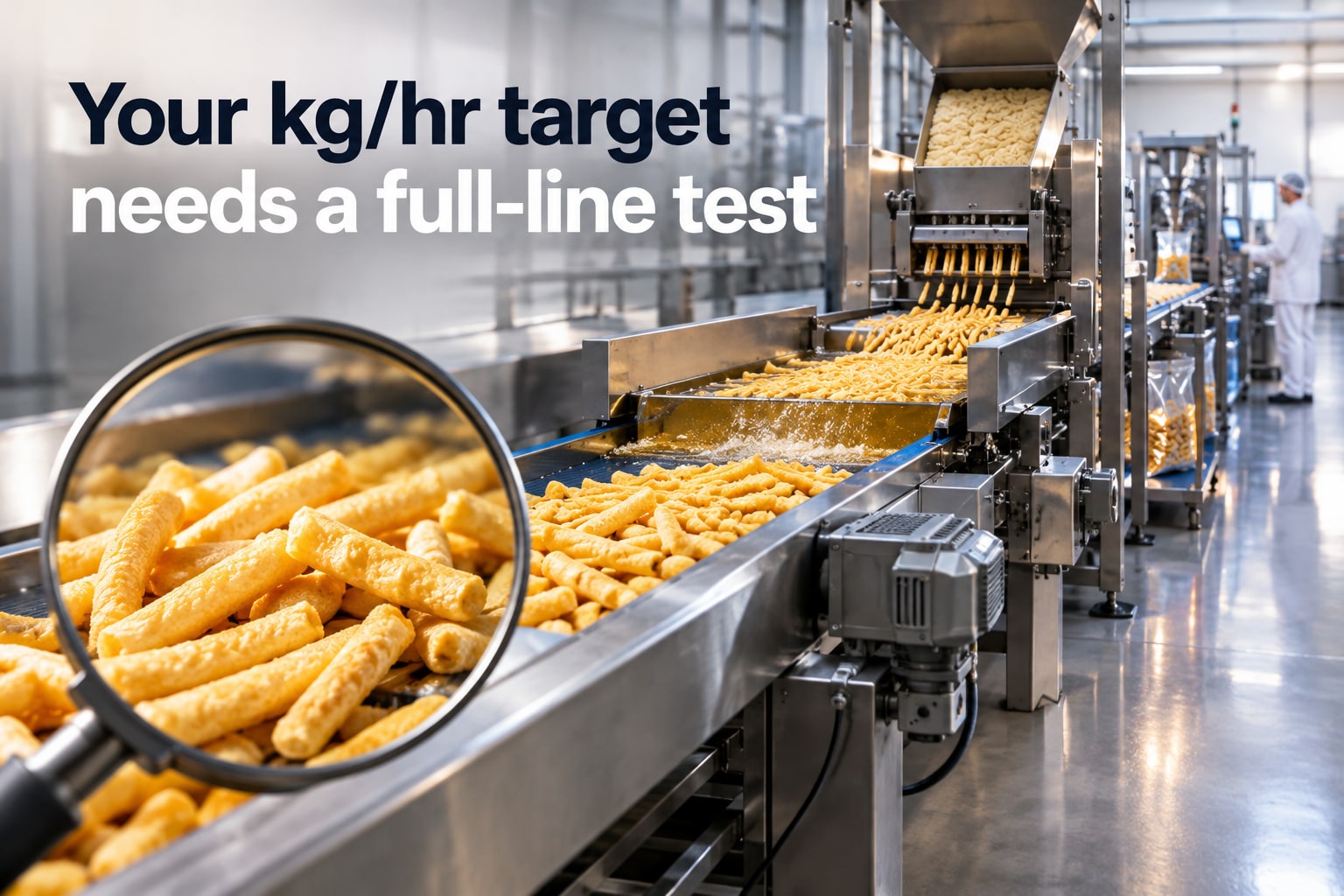
A brochure cannot prove saleable capacity. Set acceptance criteria before you compare a gold finger making machine with alternative equipment, including target product shape, finished moisture, dimensions, texture, color and acceptable breakage.
- Demand a trial with your own flour or starch, recipe, seasoning and packaging film. Reject a demonstration based only on the supplier’s formula.
- Record finished output per hour, usable yield, moisture, color, dimensions, texture, breakage, oil consumption, energy use, seal integrity, rejects, changeover time and cleaning time.
- Put the operating conditions in the quotation: feed rate, fryer temperature, belt speed, residence time, oil type, product moisture and staffing. A kilogram-per-hour figure without these controls is not a production promise.
- Inspect the cleaning method and timed disassembly. Check food-contact-material declarations, weld finish, lubricant controls, washdown limits, drainability, access to wear parts and areas where residue can collect.
- Confirm the Indian installation plan: FSSAI licensing and hygiene obligations, electrical load, compressed-air quality, exhaust, wastewater, fire protection and effluent arrangements. Record which utilities and building work the supplier excludes.
- Sign off only when the line meets the agreed figures across repeated runs, including packing performance. Document training, spare parts, warranty remedies and the procedure for correcting failed results.
A food machinery supplier in Noida can add value by integrating forming, frying, conveying and packing, then coordinating installation and after-sales support. Khan Engineering and Foods Processing Machine is relevant when that integration is required, but your witnessed acceptance test—not a claimed rating—must decide whether the line fits your product and plant.
Related products
 | Gold Finger Making Machine The Gold Finger Making Machine is a cutting-edge equipment designed to efficiently produce gold fingers used in electronic devices and connectors. View product → |
 | Packing Machine Precision Packaging for Every Business Khan Engineering offers high-quality Automatic Packing Machines designed for fast, accurate, and reliable... View product → |
Frequently asked questions
What does “gold finger” mean in manufacturing?
In electronics, a gold finger is a plated edge contact on a printed circuit board. Its line prepares PCB edges, applies nickel and hard-gold plating, cleans the boards and inspects the contacts. It is unrelated to pasta, noodles or snack production.
How do you choose between forming processes for food production?
Choose equipment from the product’s material and geometry. Extrusion suits continuous pasta and noodle strands; sheeting and cutting suit flat products; depositing or moulding suits shaped snacks; and filled products need a forming system that meters both shell and filling.
What should you compare in a gold finger snack machine comparison?
Compare usable kilograms per hour, product size range, changeover time, reject rate, fryer or dryer capacity, oil or steam consumption, cleaning access, spare parts and operator requirements. Ask whether the stated capacity includes setup losses and rejected product.
What belongs in a complete automated food production machine line?
Define raw-material feeding, mixing or dough preparation, forming, cutting, cooking or frying, cooling, seasoning, inspection, conveying, weighing, packaging, date coding, metal detection and controls. Include utilities, guarding, sanitation access and data recording.
How can you prove that a supplier’s line will meet your production target?
Run your recipe and raw materials in a witnessed trial. Record feed rate, finished kilograms per hour, piece weight, moisture or cooking result, oil or energy use, rejects, downtime and labour. Put the agreed figures and test method in the purchase contract.
Related products
 | The Macaroni Extruder Machine is a high-performance, automated system designed for producing macaroni and other pasta products. View product → |
 | Pasta Machineries 2000kg/hr Pasta & Macaroni Making Machine – Industrial-Scale Production with Precision Khan Engineering’s 2000kg/hr Pasta Making Machine is a fully... View product → |
 | Frying Machines Perfect for Small to Mid-Scale Snack Production Khan Engineering’s Batch Fryer Machine is a reliable and efficient solution for frying a wide range... View product → |
 | FOOD PROCESSING MACHINE PASTA, MACARONI MAKING MACHINE PASTA, MACARONI, NOODLES, VERMICELLI, ETC MAKING MACHINE 100KG PER HOUR FULLY AUTOMATIC MACHINE View product → |