
The purchase makes financial sense only when your orders can keep the line busy and your full production system can turn dough into saleable, packed macaroni. By measuring utilization, total cost per kilogram, drying capacity, labour, space and supplier support, you can decide whether to buy equipment, expand gradually or continue using a contract manufacturer.
Key takeaways
- Compare weekly demand with total line capacity, not the extruder’s headline output.
- Include dies, mixer, dryer, cutter, packing and installation in the purchase cost.
- Calculate break-even using usable output, labour, energy, maintenance and financing.
- Demand trial batches, moisture results, shape accuracy and sealed finished packs before buying.
When does buying an extruder beat outsourcing macaroni?
A macaroni extruder machine is worth it when one or two macaroni SKUs run several times each week and outsourced supply causes delays, high minimum orders or limited control over formulation. Compare weekly orders, production frequency, product mix and available labour—not the machine’s nameplate capacity.
A business with many short runs can lose capacity to dough flushing, die changes, cleaning and packing changeovers.
| Option | Best fit | Main trade-off |
|---|---|---|
| Manual | Small, infrequent batches and low capital availability | Lower purchase cost, but more labour and supervision |
| Semi-automatic | Moderate volumes with repeat orders | Balances labour, control and investment |
| Fully automatic continuous line | Steady demand for a narrow product range | Higher output, but warm-up, cleaning and changeovers become costly during idle periods |
Include more than the extruder footprint: reserve space for semolina and water handling, raw-material storage, finished-goods holding, cleaning access, utilities and packaging. A site without a suitable food-production area makes contract manufacturing practical, as do irregular demand, short runs and constrained cash.
Calculate planned annual saleable kilograms divided by available production hours. If that utilization is low, a high-capacity line becomes an expensive idle asset. This macaroni machine comparison should also include labour availability, dryer and packer limits, and the cost of holding inventory.
Outsourcing remains sensible until orders are frequent enough to keep the complete line productive.
What equipment and capacity must the complete line provide?
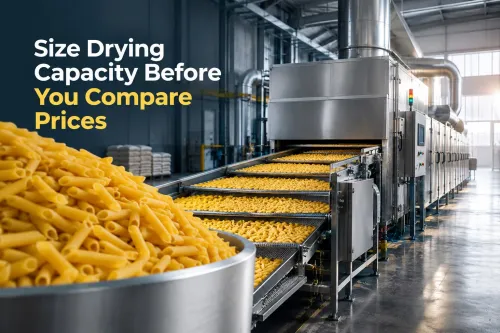
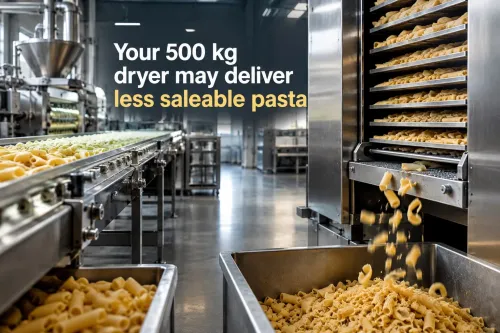
A 200 kg/hr extruder cannot produce 200 kg/hr of packed macaroni when the dryer or packer handles less. Plan the complete line from dough input in kg/hr to finished dry-pasta output after drying, trimming, changeovers and rejection.
Macaroni production equipment normally includes flour or semolina handling, dosing, water metering, a mixer or conditioner, vacuum system where specified, extruder, interchangeable dies, cutter, pre-dryer, main dryer, cooler, weighing equipment and packaging.
Ask the supplier to guarantee output using your semolina, hydration range, die diameter, product dimensions and intended moisture target. Record:
- Cut-length control, die-change time, cleaning time, power load, compressed-air demand and operator count
- Vacuum level under production conditions, dryer capacity and packer speed
- Die life and replacement cost, not only bronze or PTFE material
Macaroni machine comparison:
| Option | Strength | Trade-off | Best fit |
|---|---|---|---|
| Single-screw | Simpler operation and cleaning | Narrower formulation range | Standard semolina macaroni |
| Twin-screw | Handles pulses, fibre and gluten-free recipes | Higher cost, controls and process complexity | Businesses selling those formulations |
| Bronze insert | Rougher sauce-holding surface | Higher pressure, wear and possible output loss | Products where texture justifies maintenance |
| PTFE insert | Smoother, easier extrusion | Different wear and replacement economics | Higher-rate, smooth-surface production |
Use the formulation plan to choose the screw system; a broader capability has no value if you will not sell those products. Compare each die’s expected life, replacement price and effect on saleable kilograms.
How should you calculate macaroni extruder machine price and break-even cost?
Treat the macaroni extruder machine price as a project cost, not a brochure number. Before comparing quotations, require each supplier to identify:
- Mixer, vacuum system, die sets, cutter, pre-dryer, main dryer and cooler
- Electrical panel, compressor and thermal or boiler equipment
- Installation, freight, taxes, commissioning, training, spare parts and warranty
- Packaging integration when the line must feed a weigher or form-fill-seal machine
Calculate annual ownership cost by adding financing or depreciation, maintenance, replacement screws and barrels, die wear, electricity, thermal fuel, compressed air, water, labour, rejected product, cleaning time and planned downtime. Include a second shift, an additional operator, a generator or an electrical upgrade when the site requires one.
| Cost item | Calculation basis | Break-even effect |
|---|---|---|
| Capital | Financing or depreciation plus installation and taxes | Raises fixed annual cost |
| Production | Conservative utilization × realistic saleable kg/hour | Prevents overstating output |
| Running cost | Utilities, labour, maintenance, wear and rejects | Reveals the cost of operating |
| Lost capacity | Cleaning, changeovers, stoppages and downtime | Reduces saleable kilograms |
| Outsourcing | Purchase price plus freight, minimum-order losses, inventory and quality claims | Sets the current benchmark |
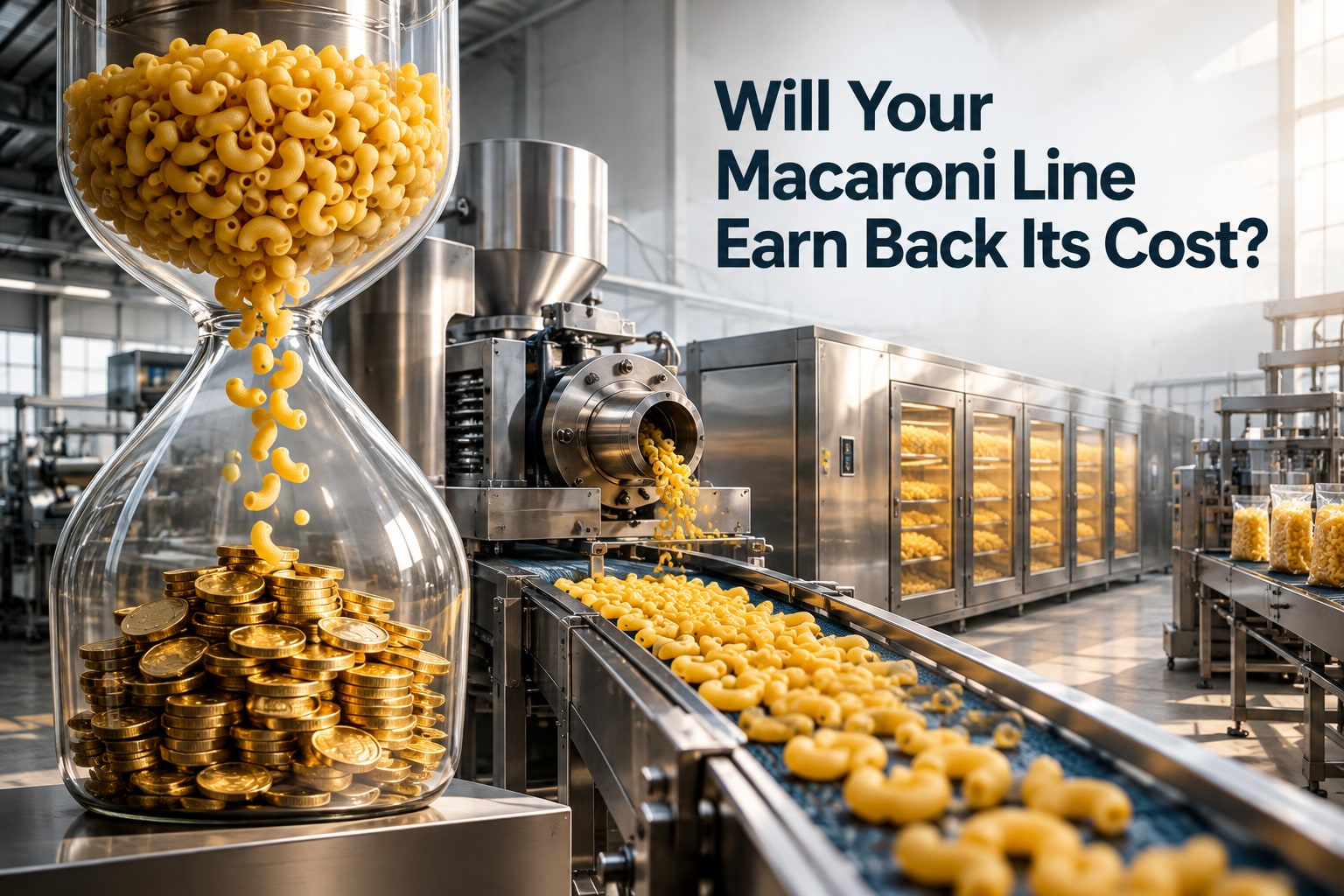
Divide the annual total by saleable kilograms, not dough input. Then compare that cost per kilogram with the outsourced benchmark and calculate payback from annual savings. A low quote loses its advantage when it excludes the dryer, installation or packaging; a higher quote can win by reducing labour, waste and stoppages.
That is how you decide whether a macaroni extruder machine is worth it.
Which production results prove that the line can make saleable macaroni?
A saleable macaroni line must prove more than extrusion speed: it must produce uniform, pack-ready pasta at the promised output. Run the process in sequence: formulate the dough, meter water, hydrate it consistently, feed the extruder, select the die and cutter, then control shape and length before pre-drying.
Dry through a stated temperature and residence-time profile, then cool the macaroni before packing. Request final moisture uniformity across trays or belts, not only an average result. Codex Standard CXS 249-2006 sets a maximum moisture level of 13% for covered pasta products.
Poor drying causes cracking, deformation, case-hardening or a wet centre beneath a dry surface.
| Test area | What to record | What failure reveals |
|---|---|---|
| Throughput | Saleable kg/hr at the promised drying condition | Extruder capacity exceeds dryer or packer capacity |
| Product quality | Moisture uniformity, piece dimensions, cooking performance and breakage | Unstable drying, cutting or extrusion |
| Operating cost | Energy use, stoppages and off-spec percentage | Output is commercially weaker than the nameplate rating |
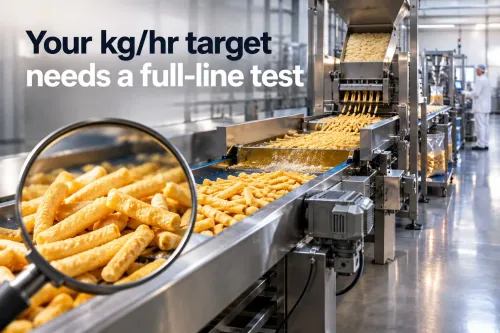
Require a factory acceptance test using your semolina, hydration, die geometry and packaging format. Record the batch number, formulation, moisture result and deviations. Ask the supplier to state maximum line output at that drying condition.
Test the actual recipe when using bread wheat, pulse flour, fibre or gluten-free ingredients; each changes water absorption, extrusion pressure and drying behaviour. A water-only demonstration does not establish commercial capacity for macaroni production equipment.
How do you vet a macaroni machine supplier before committing capital?
A nearby address does not guarantee uptime. Vet a macaroni machine supplier in Noida by testing its service promises against evidence from comparable plants.
1. Ask for references from factories making the same macaroni size at your target capacity. Call those operators and verify installation support, commissioning time, operator training, remote PLC assistance, preventive-maintenance visits and actual service-response times.
2. Request an India stock list for heaters, sensors, seals, cutters, screws, barrels and die parts. Record the normal replenishment time; a low purchase price loses value when a ₹500 sensor stops a line for three weeks.
3. Require a quotation that separates the mixer, vacuum system, dies, cutter, pre-dryer, main dryer, cooler, electrical panel, compressor, boiler or thermal system, installation, commissioning, training, spare parts, packaging integration, freight, taxes and warranty. Confirm who supplies each item.
4. Obtain food-contact-material declarations, hygienic-design details, cleaning instructions, guarding documents and electrical drawings before signing. Check the drying temperature profile, residence time, final-moisture uniformity and guaranteed saleable output at your recipe, die and product dimensions.
Khan Engineering and Foods Processing Machine belongs in the comparison only if its quotation makes those commitments measurable rather than relying on proximity. Your business remains responsible for Food Safety and Standards compliance; a local manufacturer does not transfer that duty.
Commit when service access, test results, total cost per saleable kilogram and expansion capacity support the required utilization. Otherwise, keep outsourcing or stage the purchase.
Related products
 | The Macaroni Extruder Machine is a high-performance, automated system designed for producing macaroni and other pasta products. View product → |
 | Macaroni Making Machine 50 Kg Pasta Macaroni Making Machine ₹600000 Our Macaroni Making Machine is designed for high-efficiency pasta production, offering seamless operation for continuous output. View product → |
Frequently asked questions
When does buying a macaroni extruder beat outsourcing?
Buying usually makes sense when you run one or two macaroni products several times a week, outsourced orders create delays or minimum-order pressure, and your expected contribution margin covers equipment, labour, utilities, maintenance and finance costs.
What equipment should a complete macaroni production line include?
Compare the complete line rather than the extruder alone. Check for dough mixing, extrusion, die and cutter systems, pre-drying or drying, cooling, conveying, weighing, packaging, electrical controls, installation and operator training.
How do you calculate macaroni extruder machine price and break-even cost?
Add the machine, dies, dryer, packaging equipment, installation, freight, utilities, commissioning, spare parts and financing. Divide total fixed investment by the contribution earned per saleable kilogram, then test the result against realistic weekly output and downtime.
What should you verify before choosing a macaroni machine supplier?
Request a product trial using your flour and formulation. Check saleable shape accuracy, moisture, breakage, drying consistency, output at your target specification, documentation, warranty terms, spare-die availability, installation support and references from comparable plants.
Related products
 | Pasta Extruder Machine The Pasta Extruder Machine is designed for efficient pasta production, offering high-quality and consistent results. View product → |
 | Pasta Making Machine Automatic Pasta Making Machine Simplify pasta preparation with the Automatic Pasta Making Machine. Designed for convenience, it mixes, kneads, and extrudes fresh pasta in minutes. View product → |
 | Noodles Extruder Machine The Noodles Extruder Machine is a high-performance equipment designed for producing noodles efficiently. View product → |
 | Pasta Machineries 2000kg/hr Pasta & Macaroni Making Machine – Industrial-Scale Production with Precision Khan Engineering’s 2000kg/hr Pasta Making Machine is a fully... View product → |