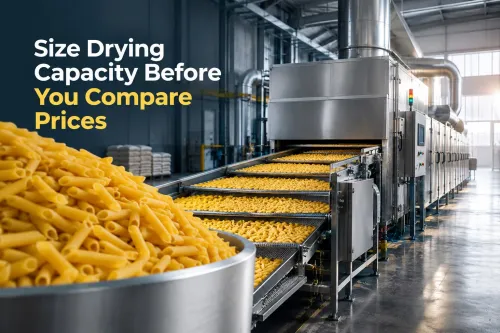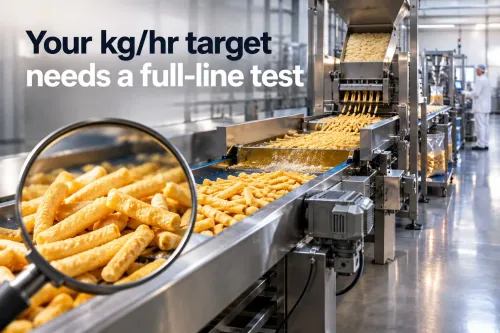

The right dryer depends on more than the chamber’s stated capacity. Compare usable output, water removal, changeover time, labour, product shape and moisture control against your actual extrusion schedule, then choose the system that delivers the lowest cost per saleable kilogram.
Key takeaways
- Choose continuous drying for stable output and long production runs.
- Choose batch drying when shapes, recipes or schedules change frequently.
- Calculate saleable kilograms after loading, drying losses and downtime.
- Match dryer residence time and humidity control to the pasta shape.
What separates continuous and batch drying in daily production?
A continuous pasta dryer versus batch dryer decision starts with flow: continuous equipment suits a stable extruder output, while batch equipment suits variable production and frequent recipe or shape changes. Continuous drying maintains a defined residence-time profile; batch drying lets you set a separate temperature and humidity schedule for each loaded trolley or tray.
| Option | Daily production effect | Main trade-off |
|---|---|---|
| Continuous dryer | Steady, high hourly throughput with automatic loading, conveying and unloading | Needs synchronized extrusion, cutting, transfer, cooling and packing |
| Batch dryer | Output depends on tray loading, drying cycle, door opening and unloading | Isolates operations and handles short campaigns more easily |
| Continuous dryer | Lower labour per tonne after commissioning | A stoppage leaves product at different drying stages, creating mixed moisture and rework |
| Batch dryer | Higher handling labour per finished tonne | Operators can separate lots, shapes and formulations |
| Continuous dryer | Larger integrated footprint, with multiple zones and conveyors | Higher controls complexity and capital requirement |
| Batch dryer | Smaller equipment footprint, though staging space is needed for loaded trolleys | Lower initial capital, but more idle time between cycles |
| Continuous dryer | Repeated heat-up losses are reduced during uninterrupted running | Fans, heaters and humidity controls run continuously |
| Batch dryer | Energy is spent on each chamber heat-up and cooling cycle | Actual consumption depends on insulation, heat recovery and load utilisation |
The critical pasta dryer comparison is not only tonnes per hour. Compare usable output and water removal in kilograms per hour, then check whether the available room can stage trays, trolleys and finished lots.
Batch drying is the safer operational choice for many shapes, fragile nests or intermittent extrusion. Continuous lines become more practical when saleable volume is high enough to keep the extruder and dryer loaded for long, uninterrupted runs.
How a continuous pasta drying machine moves product from extrusion to packing
The extruder sets the pace: wet pasta must enter the line at a controlled rate, not accumulate beside it. A continuous pasta drying machine transfers cut pieces or strands onto belts, removes surface moisture during pre-drying, completes most water removal in main zones, then equalizes, cools and discharges product to packing.
| Stage | What happens | Must stay synchronized with |
|---|---|---|
| Pre-drying | Surface moisture falls and pieces become less vulnerable to sticking. | Cutting rate, belt loading and transfer speed |
| Main drying | Heated, conditioned air removes moisture through several controlled zones. | Belt speed, air temperature, relative humidity and airflow |
| Stabilization | Moisture redistributes between the surface and the pasta core. | Target residence time and final moisture |
| Cooling and discharge | Product reaches packing temperature before weighing and sealing. | Cooling airflow, packaging speed and hopper capacity |
An industrial pasta drying line does not run one constant-temperature tunnel. Each zone changes its air conditions because drying slows as surface moisture falls; residence time is controlled by belt speed and total line length.
The extruder, cutter, transfer conveyors, dryer belts, cooling section and packer must share the same production rate. Stop extrusion and the dryer still holds pasta at different stages, creating mixed residence times, uneven moisture and rework during restart.
Do not shorten stabilization to gain speed. Surface moisture can appear acceptable while the core remains uneven, causing later breakage or moisture migration in packs. Validate the finished product with moisture and water-activity measurements when shelf life or microbial control matters.
How to calculate usable batch output instead of trusting the 500 kg label
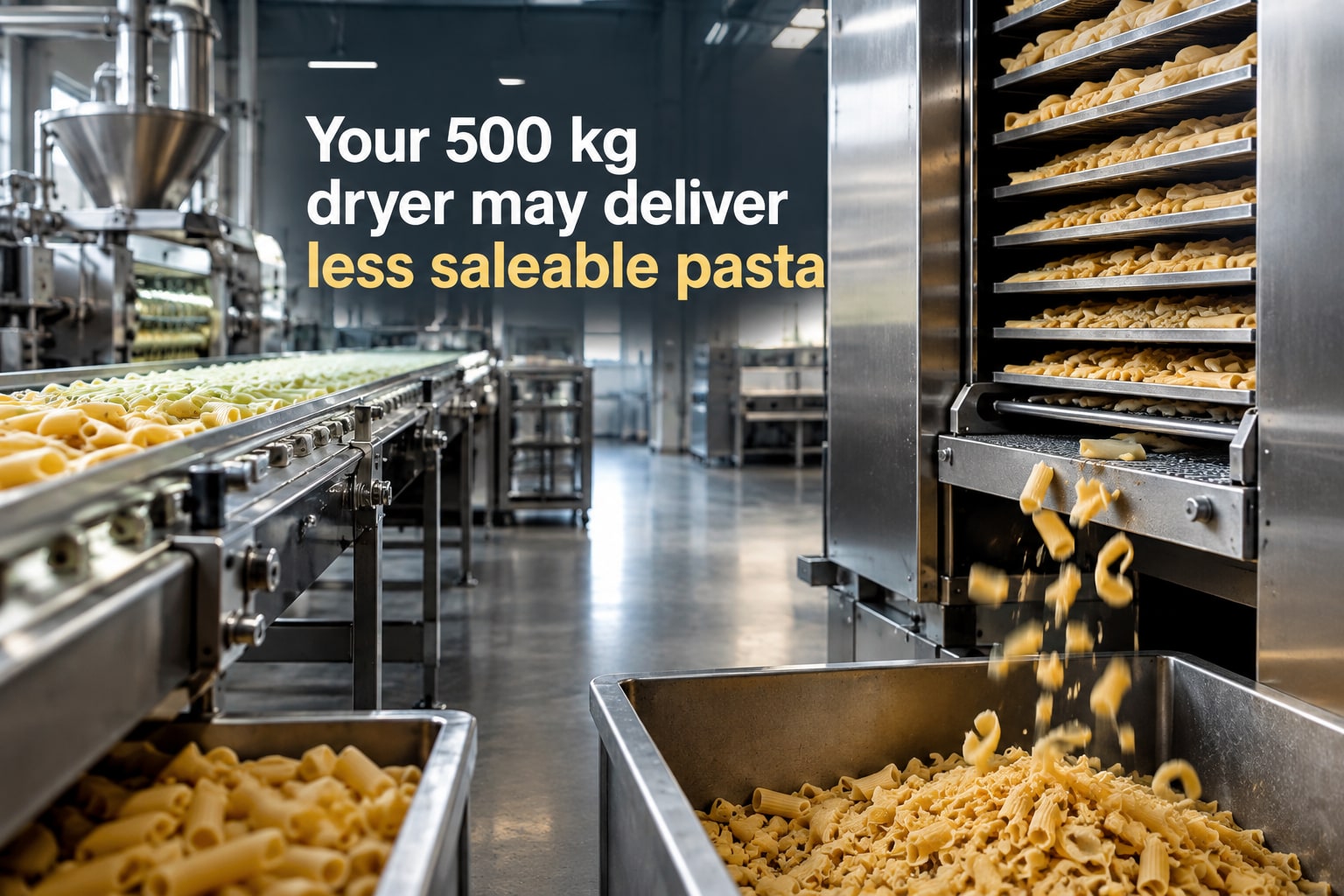
A 500 kg label is useful only after you define what it weighs and how long the equipment is unavailable. For a batch unit, count loading, drying, cooling, unloading, transfer and sanitation—not only the programmed drying time.
| Option | Calculation | Capacity result |
|---|---|---|
| Batch dryer | 500 kg finished pasta ÷ total cycle hours | A 6-hour cycle produces 83.3 kg/hour; an 8-hour cycle produces 62.5 kg/hour |
| Continuous line | Finished pasta discharged per hour × running hours | A 250 kg/hour line running 16 hours produces 4,000 kg/day before downtime |
| Water load | Finished output × water removed per finished kilogram | At 30% feed moisture and 12.5% final moisture, calculate roughly 0.20–0.25 kg water/kg finished pasta |
| Room capacity | Usable chambers × finished kg per chamber × cycles per day | Two 500 kg chambers completing three usable cycles each produce 3,000 kg/day, if labour and transfer space support it |
Use the water-removal rate as the main pasta dryer comparison, because identical finished output can impose different evaporation loads. Calculate it from solids: feed mass equals finished dry solids divided by feed solids percentage, then subtract final product mass.
Measure room capacity in saleable kilograms, not chamber volume. Leave space for trolley movement, staging, cooling and sanitation; a crowded room turns nominal batch capacity into idle time. In a continuous pasta dryer versus batch dryer decision, compare this usable batch output with the line’s actual rate after stoppages, changeovers and packaging limits.
Why pasta shape and moisture targets change the equipment decision
Moisture does not leave every pasta shape at the same rate. Select pasta drying equipment for the thickest section, the most crowded product arrangement and the greatest risk of cracking or deformation—not for average kilograms alone.
- Spaghetti needs controlled support, even airflow and careful tension management; excessive surface drying makes strands brittle and increases breakage during conveying and packing.
- Macaroni has a curved, hollow section that can retain moisture after the outside feels dry. A steep early drying profile can harden the surface while the centre remains wet.
- Penne presents thicker walls and cut ends, so airflow and residence time must remove moisture through the full tube without splitting the edges.
- Nests restrict air penetration where strands touch. Uneven loading creates wet cores, misshapen nests and higher rework.
- Filled products add a moisture-sensitive filling. The shell can crack if drying is too fast, while a wet filling raises spoilage and shelf-life risk.
- Short or irregular shapes tolerate tray handling better than long strands, but dense loading still blocks airflow and creates local moisture differences.
A continuous pasta drying machine uses separate pre-drying, main-drying, stabilization and cooling zones. Each zone changes air temperature, relative humidity, airflow and belt speed as surface moisture falls; controls should respond to product temperature and moisture, not inlet-air temperature alone.
Confirm the market specification before fixing the setpoint. In the United States, macaroni products under 21 CFR 139.110 cannot exceed 13% moisture, but that figure is not universal. Validate moisture alongside water activity because equal moisture values can still produce different shelf-life risks.
For filled or variable shapes, batch drying can reduce mixed residence times; continuous lines need uninterrupted extrusion, or product at different stages can emerge with uneven moisture.
Which dryer fits your plant: a decision based on saleable kilograms
Choose a continuous line when your extruder can feed it steadily and the resulting saleable kilograms justify dedicated flow. Choose batch equipment when product variety, intermittent production or frequent changeovers matter more than peak capacity. The commercial test is cost per saleable kilogram, not the dryer’s purchase price.
| Option | Commercial advantage | Operational risk |
|---|---|---|
| Continuous pasta dryer | Lower labour per tonne and steady high-volume output | Stops can create mixed residence times, uneven moisture and rework |
| Batch dryer | Flexible schedules and separate programmes for short campaigns | More loading, unloading, labour and idle time |
| Continuous and batch together | Buffering between extrusion and drying | Higher capital and coordination requirements |
A continuous line becomes more practical when stable demand absorbs its capacity every operating day. It becomes a poor fit when extrusion stops, because product remains at different drying stages during the interruption. Batch equipment isolates drying from an uneven upstream schedule and lets you change temperature and humidity programmes for each load.
Calculate these figures before selecting pasta drying equipment:
- Saleable kilograms per day after startup purge, cracking, rework and changeover residue
- Hours lost to sanitation, loading, unloading and packaging interruptions
- Monthly cost of rejected or downgraded product
- Moisture and water-activity results at release, not moisture alone
Ask Khan Engineering and Foods Processing Machine to compare both configurations using your actual shape mix, campaign length, stoppage history and packaging schedule. The better choice is the one that delivers more compliant packs per month, even when its installed price is higher.
Related products
 | Dryers ₹5500000 A Continuous Pasta Dryer ensures efficient and uniform drying of pasta with advanced temperature and humidity controls. View product → |
 | Dryers 500 Kg Static Batch Pasta Dryer ₹450000 The Batch Pasta Dryer is a highly efficient solution for drying pasta to perfection. View product → |
Frequently asked questions
What separates continuous and batch pasta drying in daily production?
Continuous drying suits stable extruder output and maintains a defined residence-time profile. Batch drying handles variable production with separate schedules for each trolley or tray.
How does a continuous pasta drying machine move product from extrusion to packing?
The line transfers extruded pasta through controlled drying zones, regulates residence time, then conveys the dried product toward weighing, packing and downstream handling.
How do you calculate usable batch output instead of trusting the 500 kg label?
Subtract unavailable tray or trolley capacity, changeover time, drying losses, rejects and downtime from the labelled load to estimate saleable kilograms per shift.
Why do pasta shape and moisture targets change the equipment decision?
Thick or irregular shapes require different heat, humidity and residence-time profiles than thin shapes. Your final moisture target also determines the drying schedule.
Which dryer fits a plant based on saleable kilograms?
Select continuous equipment when stable flow produces more saleable kilograms across long runs. Select batch equipment when flexibility prevents losses from frequent changes.