
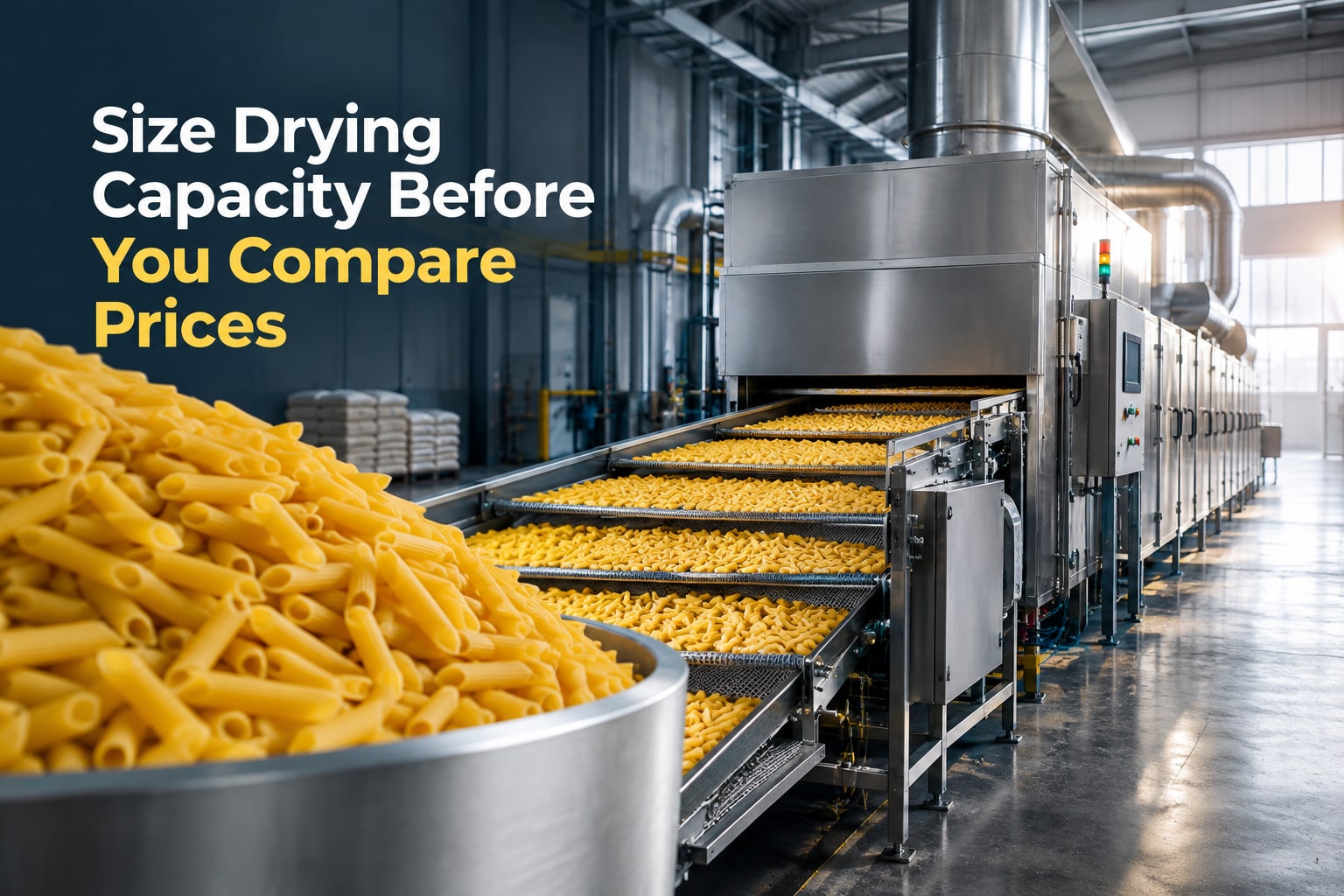
A continuous dryer quotation is incomplete if it gives only one machine price or a tonnes-per-day claim. You will be able to compare Noida suppliers on finished-pasta output, water evaporation, utilities, delivery scope and acceptance testing before committing capital.
Key takeaways
- Request a zone-by-zone quotation tied to output, evaporation load and pasta shape.
- Specify heating method, airflow, controls, insulation, utilities and stainless-steel grade.
- Confirm fabrication status, factory testing, installation schedule and spare-parts availability.
- Choose continuous drying when steady output outweighs the flexibility of batch drying.
What a continuous pasta dryer quotation in Noida should actually cost
A defensible continuous pasta dryer price in Noida does not exist as one number. Evaporation load, finished output, pasta shape, drying-zone count, heating method, automation, insulation and stainless-steel grade can shift the quotation sharply. An online figure may describe a cabinet or batch dryer, not a continuous industrial unit.
Identify the real landed project cost with this procedure:
1. Ask for separate figures for the dryer, GST, freight to your site, unloading, erection, commissioning, electrical work, ducting, utility connections, validation trials and operator training. Exclusions often cost more than the headline discount suggests.
2. Give the supplier the exact product shape, dimensions, feed moisture, target final moisture and permitted variation. Short-cut pasta, long goods, nests, sheets and noodles need different residence times and loading densities. A commercial target around 12–13% moisture is common, but confirm the specification and legal limit for your market.
3. Require the quote to state finished kilograms per hour, water evaporation per hour, number of zones, temperature and humidity by zone, air circulation, controls, data recording and footprint. Name the heat source: electric, steam, thermal fluid, gas-fired air heater or hybrid.
4. Price the required utilities separately, including a boiler, gas train, transformer, compressed-air system, exhaust and humidity-control equipment. Then confirm whether the machine is in Noida stock, locally assembled, imported or made to order, including lead time, site assembly, service and spare-parts response.
Your comparison is the complete installed cost, not the machine-only figure. Availability is real only when dispatch location, delivery access and commissioning personnel are confirmed in writing.
The production figures that determine the machine price
A supplier prices an industrial pasta drying machine from the load it must remove, not from motor size alone. State the required finished output in kg/h, feed moisture and target final moisture; these figures establish water evaporation per hour and the drying duty. A tonnes-per-day claim is not comparable without them.
| Input | What the supplier calculates | Why it changes price |
|---|---|---|
| Finished output | kg of dried pasta per hour | Determines belt, tray and chamber size |
| Water evaporation | kg of water removed per hour | Sets heating capacity, airflow and exhaust requirements |
| Pasta shape | Short-cut, long goods, nests, sheets or noodles | Changes loading density, exposed area and breakage risk |
| Moisture target | Feed and final moisture percentages | Sets the required drying duty and product quality margin |
| Residence time | Minutes from entry to discharge | Determines dryer length and belt speed |
| Drying-zone count | Separate temperature and humidity-controlled zones | Adds chambers, sensors, dampers and control complexity |
Give the exact dimensions and formulation with the shape. A long-spaghetti dryer and a short-cut pasta dryer can produce the same kg/h while needing different belt arrangements, residence times and footprints.
Request a heat-and-mass balance showing zone temperatures, relative humidity, airflow, heating medium, connected load and expected energy consumption. The supplier should also state whether the quoted evaporation rate is measured at your actual feed moisture.
More zones improve control over drying stages but increase equipment cost, controls and commissioning work. Ask for the proposed residence-time range and final-moisture average and spread, then have the machine tested with your semolina or flour and chosen product shape.
What to specify for heating, airflow, controls and plant utilities
The quotation must state a capacity range in kilograms of finished dried pasta per hour, plus kilograms of water removed per hour. It must also identify the tested pasta shapes, strand or piece dimensions, target moisture, residence time, line speed, overall footprint and maintenance clearances.
- Request a zone-by-zone heat and mass balance showing inlet and outlet moisture, temperature, relative humidity, airflow, residence time and expected energy consumption. “High-temperature drying” is not a usable specification; the final equalisation or cooling zone matters because surface-to-centre moisture differences can cause cracking.
- Specify the heating arrangement: electric heaters, steam coils, thermal fluid, gas-fired air heater or hybrid. List voltage, phase, connected electrical load, fuel consumption and every site utility, including boiler capacity, gas train, transformer, compressed air, exhaust ducting and humidity-control equipment. A low machine price can become an expensive installation when these services are excluded.
- Require an airflow drawing showing fan capacity, air velocity, circulation direction, recirculation percentage, fresh-air intake, exhaust and filtration. State the stainless-steel grade for product-contact surfaces, frame and panels; identify insulation thickness and access-door construction.
- Require a PLC and HMI schedule showing whether the industrial pasta drying machine records each zone’s temperature and humidity, alarms, recipes, residence time, production totals and energy data. Ask whether records can be exported and whether remote diagnostics are isolated from uncontrolled access to the plant network.
How to buy a continuous pasta dryer in Noida without guessing at availability
To buy continuous pasta dryer in Noida without guessing, send every pasta dryer supplier the same written specification: finished output in kg per hour, exact pasta shape and dimensions, feed and final moisture, drying-zone count, heating method and required automation. Ask for a heat and mass balance, not only a tonnes-per-day claim.
1. Request a dated quotation that separates the dryer, controls, GST, freight to Noida, unloading, erection, commissioning, electrical work, ducting, utilities, validation trials and operator training. This exposes a low machine-only price that becomes expensive after installation.
2. Ask the supplier to state the machine’s status in writing: stocked in Noida, dispatched from another city, locally assembled, imported, or made to order. Require separate lead times for the dryer, controls and imported components, plus the dispatch location and expected delivery date.
3. Confirm whether your site can receive the equipment through its entrance, lift or loading bay, and whether assembly, alignment and duct installation occur on site. Get the commissioning date, personnel availability and the number of production trials included.
4. Obtain breakdown-service response time, service coverage in Noida and a first-year spare-parts schedule with prices and quantities for belts, bearings, sensors, heaters or burners, dampers, fans, filters, seals and control components.
Include Khan Engineering and Foods Processing Machine in the comparison only after requesting these same details; identical questions make its offer comparable with imported and locally assembled alternatives.
Related product
 | Dryers ₹5500000 A Continuous Pasta Dryer ensures efficient and uniform drying of pasta with advanced temperature and humidity controls. View product → |
When continuous drying beats a 500 kg static batch dryer
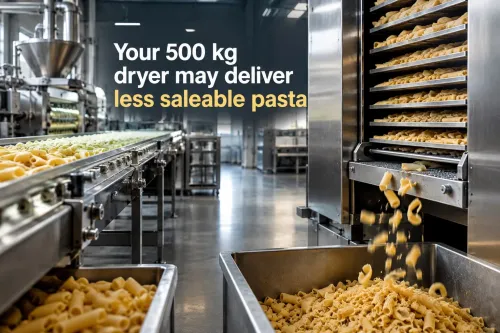
A 500 kg static batch dryer suits irregular demand, frequent recipes and unstable upstream production. Choose continuous drying when daily demand keeps the dryer loaded for most operating hours, changeovers are limited, and the extruder can deliver uniform strands without long stoppages.
A continuous dryer cannot rescue fluctuating dough moisture, die wear, cutter speed or uneven loading.
| Decision factor | Continuous dryer | 500 kg static batch dryer |
|---|---|---|
| Daily demand | High, repeatable volume | Low or intermittent volume |
| Downtime | Costly; line runs for long shifts | Easier to stop between batches |
| Changeovers | Best with few shapes and recipes | Better for many products |
| Product variety | Narrow range with fixed geometry | Short-cut, nests, sheets or noodles in rotation |
| Upstream stability | Requires steady feed rate and moisture | Tolerates interruptions more easily |
For a break-even calculation, ask the pasta dryer supplier for hourly finished output, operating hours per day, working days, batch-cycle time, labour, electricity or fuel use, rejected product, changeover minutes, maintenance and expected service life.
Include the complete installed figure—not just the advertised continuous pasta dryer price in Noida—plus lost production during downtime and extra electrical or ducting work.
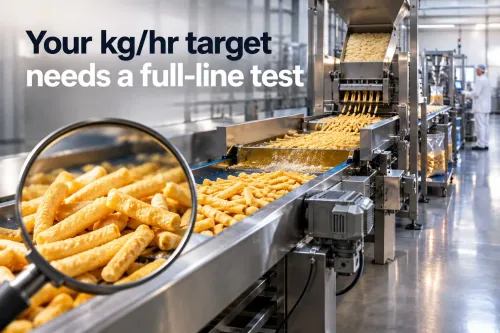
Test the quoted capacity with your actual semolina or flour, shape, dimensions and feed moisture. Put these acceptance criteria in writing:
- Continuous run for a defined shift or agreed hours without stoppage
- Hourly output and final moisture average within the specified spread
- Product temperature, breakage or deformation rate and energy consumption recorded
- Stable operation after start-up, including alarms, airflow and data logging
Frequently asked questions
What determines a continuous pasta dryer price in Noida?
Price depends on finished output, evaporation load, pasta shape, drying-zone count, heating method, automation, insulation and stainless-steel grade. Ask for each cost driver in the quotation instead of accepting one undifferentiated figure.
What production figures should I provide for a quotation?
Provide fresh-pasta feed rate, target finished output, moisture before and after drying, pasta shape and dimensions, operating hours, drying temperature, and the required production capacity. These figures let the supplier size the dryer and estimate the evaporation load.
What should I specify for heating, airflow and controls?
Specify the heating source, temperature range, airflow direction and adjustment method, humidity control, drying-zone count, sensor locations, PLC and HMI functions, alarm records, insulation thickness, electrical load and compressed-air requirements.
How can I confirm availability before buying a continuous pasta dryer in Noida?
Ask whether the machine is ready stock, under fabrication or built to order. Confirm the promised dispatch date, factory-acceptance test, installation scope, commissioning team, spare-parts list and after-sales response process in writing.
When does continuous drying beat a 500 kg static batch dryer?
Continuous drying suits steady production, repeatable residence time and integration with an automated pasta line. A 500 kg static batch dryer suits variable recipes, smaller runs or operations that value flexible loading over uninterrupted throughput.