
The right equipment depends first on the product, then on saleable output, utilities, labour and demand—not on a catalogue capacity number. By the end, you will be able to compare a chip line with namkeen, extruded-snack and manual or semi-automatic setups, identify the costs hidden in a quotation, and prepare a practical Nashik installation brief.
Key takeaways
- Choose slicing and frying for potato, banana and cassava chips.
- Compare saleable output, not hourly machine capacity alone.
- Match automation with labour, utilities, floor space and expected Nashik demand.
- Request a written quotation and factory trial before selecting equipment.
Start with the product: potato chips, banana chips or an extruded snack?
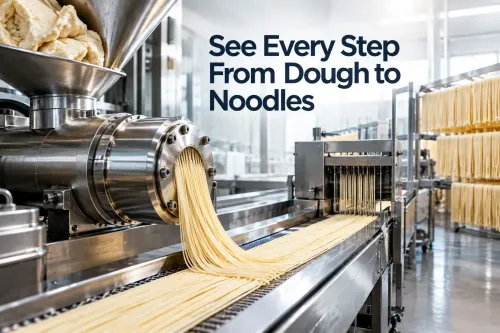
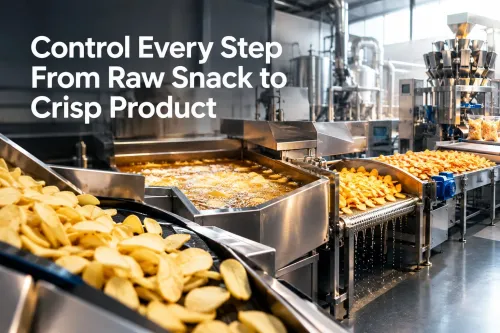
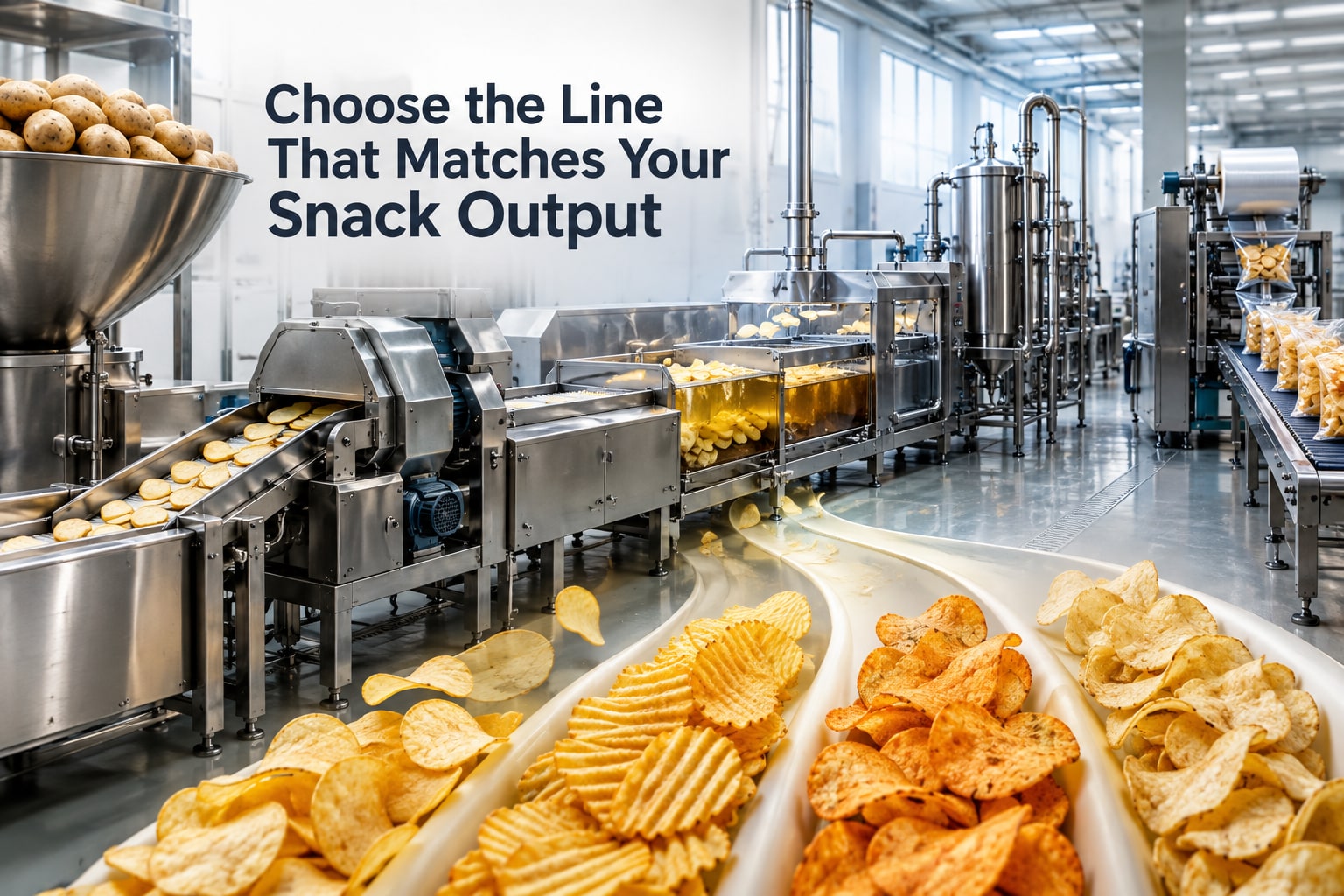
Choose the snack shape first: sliced potato, banana or cassava chips need a slicing-and-frying process, while Kurkure and puffed snacks need extrusion. A commercial chip production machine may mean a complete potato-chip line—washing, peeling, slicing, optional blanching, dewatering, frying, de-oiling, seasoning and packaging—or only one stage.
| Option | Process and equipment | Key raw-material behaviour |
|---|---|---|
| Potato chips | Wash, peel, slice, blanch if required, dewater, fry, de-oil and season | Potato variety, reducing sugar, moisture and slice thickness control colour and oil uptake |
| Banana or cassava chips | Peel, slice to a product-specific thickness, then fry and season | Firmer, starchier slices need different feed handling and frying recipes; trial each variety |
| Namkeen or sev | Mix dough, form sev or other shapes, then fry | Dough consistency and forming dies determine shape, not a potato slicer |
| Kurkure or puff snacks | Extrude, cut, then dry or fry and season | Expansion depends on extrusion conditions and moisture removal |
| Manual production | Use separate slicers, baskets and batch fryers | Flexible and inexpensive to start, but labour, consistency and throughput limit growth |
For chip making machine vs other snack machines in Nashik, compare the process rather than the quoted kilograms per hour. A batch fryer suits varied recipes and smaller runs; extrusion suits shaped snacks, not sliced chips. Manual equipment suits testing demand, while an integrated line suits repeatable volume.
Do not select an extruder for sliced chips. Do not assume a potato line will process banana or cassava: confirm slicing, blanching, frying temperature and residence time through a product trial.
Compare capacity by saleable output, raw material and frying method
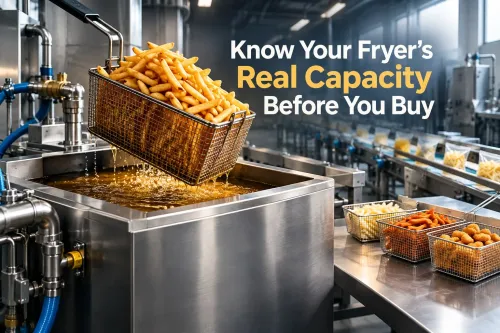
A 1,000 kg/h quote does not prove 1,000 kg of saleable chips. Fix the potato variety, tuber size, storage history, reducing-sugar level, moisture and target slice thickness before comparing capacity.
Ask every supplier to state whether capacity means raw potato input or finished product, plus slice thickness and tolerance, feed moisture, frying temperature, residence time, and whether the figure is theoretical or measured continuously. Thin slices fry faster but break more easily; potatoes with high reducing sugar can produce dark, over-fried rejects.
| Frying method | Best fit | What the line must control |
|---|---|---|
| Batch frying | Varied recipes, smaller runs and flexible SKUs | Batch weight, loading time, temperature recovery and recipe changeovers |
| Continuous frying | Higher, stable volume | Metered feeding, constant residence time, oil filtration, exhaust, heat management and downstream conveying |
A useful chips manufacturing machine comparison uses finished saleable output per shift, not the catalogue rating of a commercial chip production machine. Calculate: raw input × usable yield after peeling and trimming × accepted-slice rate × frying and quality acceptance rate × operating hours.
Deduct broken slices, dark or over-fried rejects, seasoning and packaging rejects, cleaning, changeovers and unplanned downtime.
Require a trial with your potato lot and target thickness. Record saleable kilograms, oil temperature, residence time, rejects, cleaning duration and continuous run performance; two machines with identical quoted kg/h can deliver very different daily output.
Match automation level to labour, utilities, space and Nashik demand
Choose the smallest configuration that meets confirmed demand without exceeding your workforce or site utilities. A large line leaves capital idle when Nashik orders are uncertain; a batch fryer becomes the bottleneck when sustained high-volume output is required.
| Option | Best fit | Workers still required |
|---|---|---|
| Manual preparation with fryer | Small tests, varied recipes and limited capital | Load and slice potatoes; inspect; fry and season; pack; clean; complete oil, weight and quality checks |
| Semi-automatic slicing, frying and seasoning | Growing local or wholesale demand | Load slicer and fryer; inspect slices and colour; supervise seasoning; pack manually or semi-automatically; clean and check quality |
| Integrated continuous line | Stable, higher-volume demand with repeatable products | Load and inspect raw material; monitor fryer and seasoning; supervise packing; clean; perform quality checks |
| Fully automated plant with conveying and packaging | Predictable volume, labour savings and multiple downstream stations | Load raw material; monitor inspection points, seasoning and packaging; clean; conduct quality checks and respond to stoppages |
Before comparing a chip making machine in Nashik, request connected electrical load, fuel or gas consumption, water pressure and quality, compressed-air pressure and filtration, drainage, wastewater handling, exhaust ventilation, floor loading and maintenance clearances.
Reserve separate raw-material and fried-product zones. Check that a workshop vehicle can reach the installation point, electricians can access panels, spare parts are available locally, and the supplier gives a realistic Nashik service response. Compare snack production machinery in Nashik by saleable output and labour, not the quoted motor rating alone.
Include oil management, packaging, sanitation and quality control in the comparison
Saleable output depends on oil control, hygienic design and packaging—not the slicer alone. Include filtration, safe draining, sludge removal, oil sampling and used-cooking-oil disposal in the chips manufacturing machine comparison. FSSAI sets the total polar compounds limit at 25%; stop using oil above that limit.
| Option | Product handling and packaging | Downstream controls |
|---|---|---|
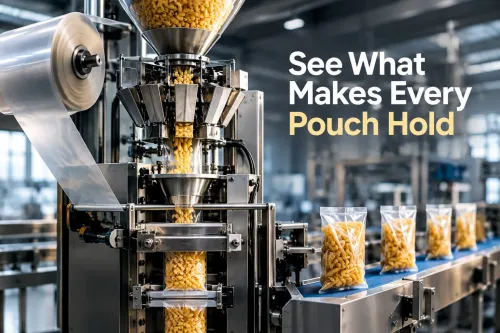
| Fragile potato or banana chips | Gentle conveyors, multihead weigher, nitrogen flushing, suitable seal width, date coder and metal detector | Check breakage, pack weight, oxygen, seal integrity and foreign bodies |
| Namkeen and sev | Stronger conveying for varied shapes and fried mixtures; seasoning must resist fines segregation | Check seasoning dosage, moisture, weight and seal integrity |
| Kurkure and puff snacks | Extrusion, drying or frying creates lightweight, brittle pieces needing low-drop transfer | Check bulk density, crispness, moisture, nitrogen level and coding |
| Manual or semi-automatic line | Separate weighing and packing increase labour and handling damage | Check every batch for weight, colour, crispness and seal leaks |
Sample oil during production and record temperature, colour, residence time, filtration results and total polar compounds. Remove settled sludge before it burns onto fryer surfaces.
Specify accessible product-contact parts, cleanable blades, fryer surfaces, conveyors and seasoning systems. Separate raw-potato handling from fried-product and packaging zones to limit recontamination.
Your labour and downtime calculation must include daily cleaning, oil filtration, blade inspection and seal inspection, plus safe oil draining and changeovers. Check slice uniformity, oil temperature, colour, moisture, crispness, seasoning dosage, pack weight and seal integrity before release. For snack production machinery in Nashik, compare these operating hours—not catalogue capacity.
Use a Nashik supplier quotation and factory trial to make the final decision
Ask every chip making machine in Nashik supplier for a written quotation and acceptance plan before comparing prices. A commercial chip production machine may cover only slicing and frying, so identify every included and excluded stage: washing, peeling, slicing, blanching, dewatering, frying, de-oiling, seasoning, conveying and packaging.
1. Require rated and guaranteed output, stated as raw input or finished saleable product; batch size or continuous feed rate; slice thickness and tolerance; fryer temperature and residence time; oil filtration; heating source; connected electrical load, fuel and compressed-air needs.
2. Specify contact-part material, weld finish, guards, controls, emergency stops, cleaning access, and included packaging equipment. List floor preparation, installation, commissioning, recipe trials, operator training, warranty, preventive-maintenance schedule, spare-parts list and service response time as separate inclusions or exclusions.
3. Ask for electrical and pneumatic drawings, calibration procedures, cleaning instructions and a written list of consumables. Reject “high efficiency” without a measurable guarantee.
Make the supplier run your own potato lot at your target slice thickness, seasoning and packaging film. Record saleable kilograms per shift, oil use, rejects, labour required, changeover time and pack-seal results; also record potato variety, slice tolerance, oil temperature and residence time. This factory trial exposes the gap between catalogue capacity and usable output.
Evaluate Khan Engineering and Foods Processing Machine, or any supplier of snack production machinery in Nashik, against these recorded results and the promised commissioning scope. Choose the line that meets your saleable-output target with documented uptime, cleanability, support and pack quality—not the one with the largest generic kilogram-per-hour claim.
Related products
 | Chip Making Machine A Chip Making Machine is an advanced piece of equipment designed to efficiently produce high-quality chips used in various industries. View product → |
 | Packaging Machine The Snacks Packaging Machine offers high efficiency in packaging a variety of snack products. View product → |
Frequently asked questions
Which machine suits potato, banana and cassava chips?
Choose a slicing-and-frying line with washing, peeling where required, slicing, dewatering, frying, de-oiling, seasoning and packaging stages.
How do chip lines differ from extruded snack machines?
Chip lines process sliced raw materials in a fryer, while extruded snack lines cook and shape a prepared dough through an extruder before drying or frying.
What should you compare besides machine capacity?
Compare saleable output, raw-material yield, frying method, oil management, labour, utilities, floor space, sanitation, packaging and quality-control requirements.
How can you evaluate a Nashik snack-machine quotation?
Ask for component specifications, guaranteed output, utility consumption, installation scope and a factory trial using your recipe and raw material.
Related products
 | Snacks Making Machine Khan Engineering offers a high-performance Namkeen Making Machine designed for smooth, hygienic, and efficient commercial snack production. View product → |
 | Kurkure Making Machine The Kurkure Making Machine is designed for producing crispy, crunchy snacks like Kurkure with high efficiency. View product → |
 | Puff Making Machine The Puff Making Machine is a state-of-the-art device designed for producing crispy, puffed snacks with ease. View product → |
 | Frying Machines Perfect for Small to Mid-Scale Snack Production Khan Engineering’s Batch Fryer Machine is a reliable and efficient solution for frying a wide range... View product → |