
A noodle line does more than push dough through a die: it measures ingredients, develops the dough, forms and cuts the product, then applies the correct steaming, drying, cooling and packing steps. By following the material path and the critical settings, you can understand how a commercial line works, diagnose defects and judge whether a quoted machine will produce your required noodle.
Key takeaways
- Measure flour and water before mixing for consistent dough plasticity.
- Match die holes, screw speed, and cutter timing to the target noodle.
- Control drying temperature and humidity to prevent cracks and uneven moisture.
- Check guarding, emergency stops, sanitation access, and test-run samples before acceptance.
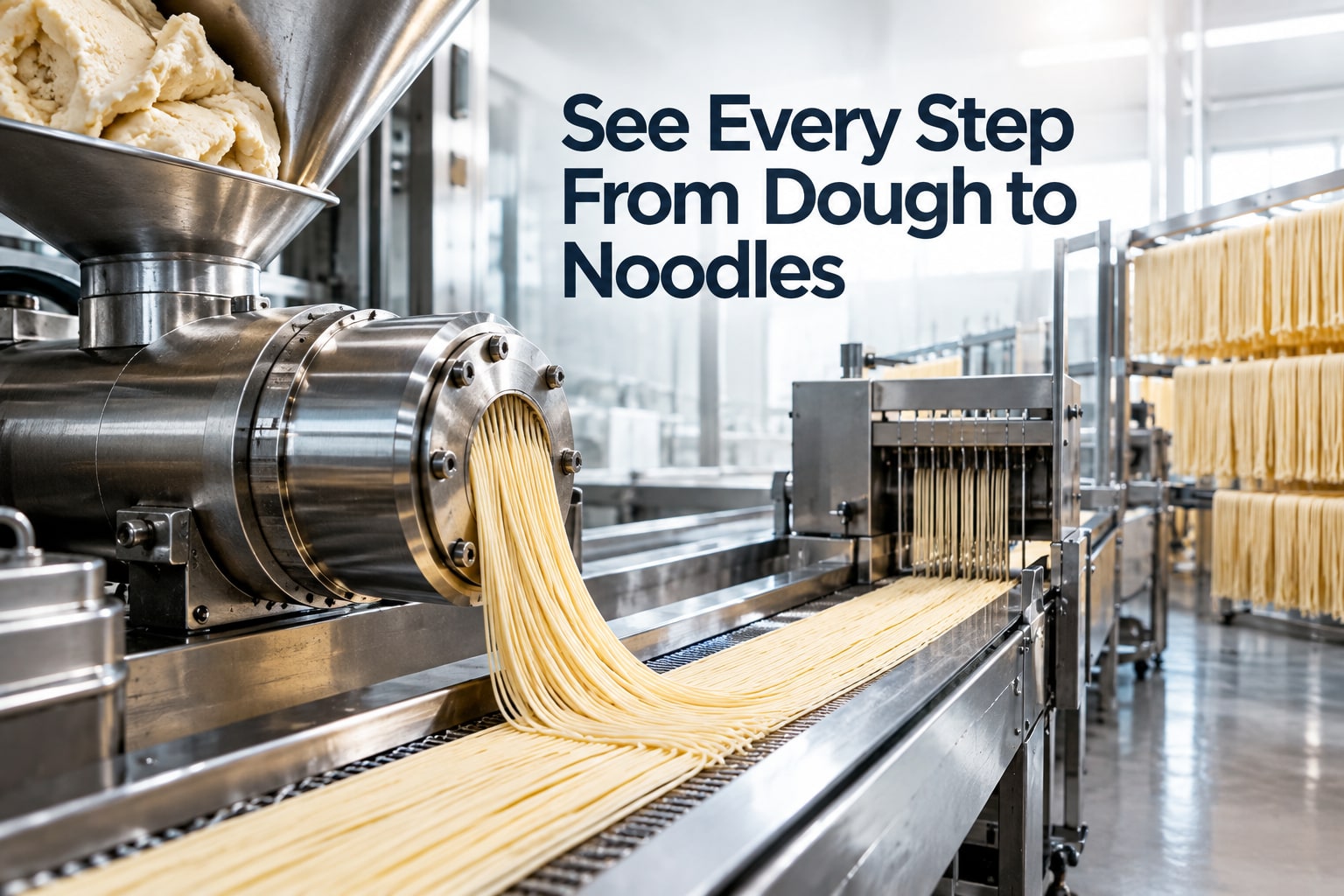
From Ingredient Dosing to Extrusion: The Dough’s Physical Path
Flour and water enter the line as measured ingredients, not as a ready-made dough. The noodle extruder machine process turns them into a uniform, plastic mass, then pushes that mass through a shaped die; every stage before the die affects strand strength, surface and cooking quality.
1. Flour dosing weighs the base ingredient into a hopper. Liquid dosing adds water, salt, alkaline solution or other recipe liquids at a controlled rate; too much water creates sticky dough, while too little leaves dry pockets.
2. A mixer or kneader distributes liquid through the flour. Mixing time and dough temperature matter: incomplete mixing leaves hard lumps, and excessive heating changes hydration and weakens the dough.
3. The mixed dough passes to a resting or conditioning section when the recipe requires it. This allows moisture to migrate into flour particles before extrusion, reducing dry cores and unstable flow.
4. A screw conveyor collects the conditioned dough and moves it through the barrel. Its flights convey, compress, mix and shear the mass, while the compression zone removes voids and builds a continuous feed.
5. The screw forces dough against the die, where resistance creates pressure and additional heat. Output depends on feed rate, screw speed, moisture, screw design, die resistance and product temperature—not motor size alone.
6. The die divides and shapes the compressed dough into strands or specialty forms. A cutter then portions the discharge, and a conveyor carries the formed noodles toward steaming, drying, frying, cooling or packing.
Extrusion is not the same as sheeting and slitting. Many ramen-style and alkaline wheat noodles begin as a rolled sheet, while noodle production equipment for fresh pasta-like products may form strands directly through an extruder die.
How the Die, Screw and Cutter Control Noodle Shape and Length
A buyer searching “how a noodle extruder machine for works” is really asking how dough becomes a controlled strand. In a commercial noodle extruder, the screw conveys, compresses, mixes and shears the dough before forcing it through the die.
Screw speed, feed rate, moisture, screw design, die resistance and product temperature together determine output; motor size alone does not.
The die fixes the noodle’s cross-section, so changing tooling changes the product rather than merely adjusting software.
- Round holes produce cylindrical strands.
- Flat openings produce ribbons.
- Hollow openings create tubes.
- Shaped openings create specialty profiles.
A smaller opening or longer land increases resistance and die pressure. That pressure can improve surface smoothness and dimensional control, but excessive resistance raises product temperature, reduces throughput and causes rough strands or breakage. A worn, scratched or poorly aligned die leaves streaks and uneven surfaces.
Thickness depends on die opening, dough pressure and the die’s calibration. Measure strands after discharge, because hot dough can relax or expand slightly.
The cutter controls length only after the die and screw establish mass flow. Synchronise cutter speed with screw speed, die-hole count and actual output. Too slow, and strands become overlong or pile up; too fast, and pieces become short with ragged ends.
For acceptance, run the buyer’s recipe and tooling, not water alone. Record strand dimensions, die pressure, product temperature, throughput, cut-length variation, downtime and changeover time.
What Happens After Forming: Fresh, Dried and Instant Noodles
The die only creates the strands; the downstream line determines whether they become fresh, dried or instant noodles. After cutting, a discharge conveyor carries portions to the route selected for the recipe. The noodle extruder machine process therefore needs more than a forming unit: steaming, drying, frying, cooling and packaging require separate noodle production equipment.
| Product route | Steps after cutting | Finished result |
|---|---|---|
| Fresh noodles | Portion, dust or lightly oil to prevent sticking, inspect, chill when required, and seal in packs | Soft noodles with controlled moisture and a short shelf life |
| Dried noodles | Convey through staged hot-air drying, equalise moisture, cool, inspect and pack | Shelf-stable noodles with a firm texture after cooking |
| Instant noodles | Steam to gelatinise starch, form portions or waves, fry in oil or dry with hot air, cool and pack | Quick-cooking noodles with either porous fried texture or lower-fat air-dried texture |
Do not confuse extrusion with every noodle-forming method. Alkaline wheat noodles, ramen-style noodles and many fried instant noodles begin as a rolled dough sheet that is slit into strands; an extruder is not required for that stage.
Frying removes moisture quickly and creates the familiar porous structure, but it increases oil use, energy demand, oil-quality checks and fat content. Hot-air drying reduces those trade-offs but changes texture and drying time. In either route, inspect strand dimensions, portion weight, residual moisture, colour, breakage and seal integrity before release.
A forming extruder alone cannot produce packaged instant noodles.
Operating the Line Safely and Correcting Common Defects
Start with guards fitted, the die and cutter secured, and the emergency stop released. Check that flour, water, compressed air, drainage and downstream conveyors are available before energising the commercial noodle extruder. Keep hands away from the hopper, screw, die and cutter; isolate and lock out electrical power before removing a jam.
- Run the mixer or kneader empty, then add the approved flour and liquid according to the recipe.
- Allow the dough to condition for the specified time before feeding it steadily into the hopper.
- Start the screw at low speed, confirm smooth discharge, then increase speed while watching die pressure and product temperature.
- Synchronise cutter speed with extrusion output and inspect strand thickness and cut length at regular intervals.
- Stop liquid and flour feed first, reduce screw speed, clear remaining dough through the die, stop the cutter and conveyor, then isolate power.
Uneven strands usually indicate inconsistent feeding, a partially blocked die, incorrect screw speed or dough with uneven moisture. Too little water raises die pressure and causes breakage; too much creates sticking, deformation and a heavier drying load. Adjust moisture in small measured steps, not by pouring water into a running hopper.
- Sticking: check excess moisture, hot dough and a dirty die; correct the recipe and clean the die.
- Breakage: check low moisture, excessive pressure and blunt cutting edges.
- Moisture variation: verify liquid dosing, mixing time and dough conditioning.
After shutdown, lock out the machine, let hot parts cool, remove dough from the screw, die and cutter, and wash food-contact parts with approved detergent. Rinse, sanitise, dry fully and record cleaning time. The noodle extruder machine process is not controlled until production logs capture pressure, temperature, downtime and finished-product checks.
How to Specify and Accept a Commercial Noodle Extruder
A noodle extruder machine in Nashik needs a site-specific specification, not a catalogue capacity. Confirm the product, recipe, die size and target output before comparing suppliers; screw speed, feed rate, dough moisture, die resistance and temperature govern output more than motor rating.
1. State capacity as kilograms per hour for your actual recipe, not an empty-machine claim. Require trials at target strand dimensions and record throughput, die pressure, product temperature, cut length and rejected product.
2. Measure the installation point before ordering. Confirm electrical phase, voltage, connected load, compressed-air pressure and consumption, process-water quality, drainage level, ventilation, wastewater route, access doors, floor loading, ceiling height and space for cleaning and maintenance.
3. Specify hygienic construction in writing. Product-contact parts should be identifiable food-contact materials with smooth, cleanable welds; require guarded drives, removable die parts, accessible inspection points and a documented cleaning method. Match the layout to FSSAI licensing, Schedule 4 hygiene practices and your premises’ pest-control and waste-handling arrangements.
4. Make the factory acceptance test use your flour, water, recipe, tooling and operators. Record start-up time, changeover time, cleaning time, downtime, strand dimensions, cut-length consistency and finished-product quality. A water-only or no-load demonstration proves neither capacity nor noodle quality.
5. Confirm what the quotation excludes. A commercial noodle extruder may form strands but not mix, steam, dry, cool or pack them. Ask for a scaled layout showing every upstream and downstream machine, service connection and product-transfer point.
Khan Engineering and Foods Processing Machine can use these recorded requirements to distinguish a forming machine from complete noodle production equipment before installation.
Related products
 | Noodles Extruder Machine The Noodles Extruder Machine is a high-performance equipment designed for producing noodles efficiently. View product → |
 | Noodles Making Machine Our Noodles Making Machine is designed for efficiency and precision, producing high-quality noodles with minimal effort. View product → |
Frequently asked questions
How does a noodle extruder machine produce noodles from start to finish?
It doses flour and water, mixes and conditions the dough, conveys it with a screw, presses it through a shaped die, cuts the strands, and sends them to fresh, drying, or instant-noodle processing.
How do the die, screw, and cutter affect noodle shape and length?
The die determines cross-section, the screw controls conveying and pressure, and cutter speed and timing determine strand length. Changes to any of these affect uniformity and surface quality.
What happens after noodles leave the extruder?
Fresh noodles move to portioning or packing, dried noodles pass through controlled drying and cooling, and instant noodles are steamed, cut, shaped, fried or hot-air dried, then cooled and packed.
How do you choose and accept a commercial noodle extruder?
Specify the noodle type, flour and water range, output, die formats, cutter range, downstream process, utilities, guarding, sanitation features, and controls. Accept the line only after a documented production trial checks shape, length, moisture, defects, and safe operation.
Related product
 | Pasta Making Machine The Noodles Pasta Making Machine is a versatile and efficient solution for creating fresh noodles and pasta. View product → |