
An automatic pouch line must coordinate product dosing, film movement, pouch formation, heat sealing, cutting, coding and discharge; a fault in any one stage can produce underweight packs, drifting artwork or leaking seals. By following the operating sequence and matching the filler, film and controls to your product, you can evaluate test packs and specify a machine that is ready for production rather than judging it by speed alone.
Key takeaways
- Match the filler to product flow, particle size and dosing accuracy.
- Use eye-mark sensing and encoder feedback to align film, seals and cuts.
- Prove seal strength and leak resistance before releasing production packs.
- Compare suppliers using trial runs, inspection records and finished-pack evidence.
The operating sequence: from film roll to finished pouch
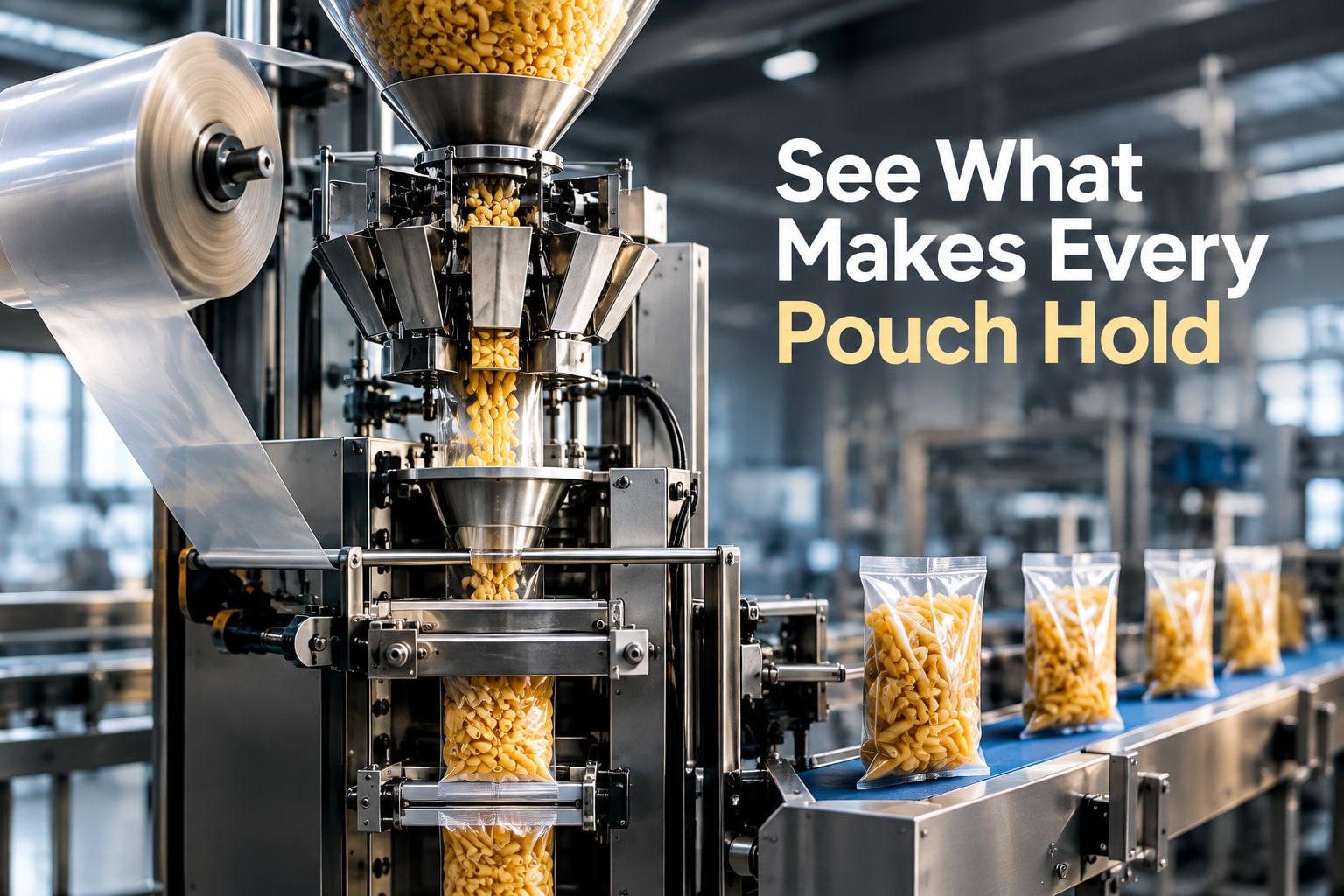
1. A complete automatic packing machine process starts as the film roll unwinds under controlled tension. An eye-mark sensor detects the printed registration mark, while an encoder or servo reference tracks film travel so artwork, seals and cuts stay aligned.
2. Film passes over guides and around a forming collar. The collar turns flat film into a pillow-style tube or a gusseted tube, while the forming set brings the edges together for a vertical, or longitudinal, seal.
3. Product feeding equipment supplies the hopper. A suitable filler—not just a forming and sealing unit—measures each portion and doses it through the forming tube into the open pouch.
4. Longitudinal sealing closes the tube seam. Horizontal sealing jaws then close across the tube to form the bottom of one pouch and the top of the next; the cutter separates finished packs. A date or batch coder marks the web or pouch at its registered position.
5. The finished pouch discharges onto a conveyor for weight, seal, code or presence checks. A reject device removes underweight packs, open seals, missing products or unreadable codes instead of sending them to cartons.
6. In intermittent-motion VFFS, film stops for dosing, horizontal jaw closure and cutting. Continuous-motion machines keep film moving, increasing timing demands for product flow, film tracking, seal response and jaw synchronisation.
7. Reliable automatic pouch packing machine operation depends on matching the filler to the product and controlling every reference point. A machine that only forms and seals pouches is incomplete; the filler, coder, inspection and rejection equipment must work as one system.
Choose the filler by product behaviour, not pouch size
Pouch size does not choose the filler; product behaviour does. The food packing machine working correctly depends on whether the product flows, bridges, breaks or varies in density—not simply whether it fits the pouch. For pasta, noodles and other products, select the dosing method before specifying the pouch.
| Option | Best fit | Main limitation |
|---|---|---|
| Volumetric cups | Relatively uniform, free-flowing pasta, noodles and granules | Density changes alter weight |
| Auger filler | Flour, spices and other powders | Bridging and compaction affect feed |
| Multihead weigher | Discrete free-flowing pieces such as chips, nuts and snacks | Product breakage can increase giveaway |
| Linear weigher | Simpler weighed portions needing controlled feed | Less combination flexibility |
| Piston or pump | Many liquids and pastes | Viscosity and trapped air affect dose |
A gravimetric filler uses fast bulk feeding, then slower dribble feeding near the target. Load cells check actual weight, and the controller uses each result to adjust later doses. This explains how automatic packing machine for works in practice: the filler responds to measured product, not a fixed volume.
Density changes, bridging and poor flow cause underweight packs or inconsistent fill levels. Excessive handling can break snacks and create giveaway. Specify these values before comparing machines:
- Target weight and allowable variation
- Minimum and maximum product density
- Throughput at the target weight
- Required weighing standard and verification method
How the controls keep filling, film and sealing in time
The PLC runs the automatic packing machine process as a timed sequence, while the touchscreen HMI is where you enter pack length, fill quantity, speed, alarm limits and product recipes. The food packing machine working depends on each device reporting its position or condition before the next step starts.
| Component | Control role | What failure causes |
|---|---|---|
| Photoelectric eye-mark sensor | Detects the printed registration mark | Artwork drift, torn notches or misplaced seals |
| Encoder or servo reference | Tracks film travel and jaw position | Cut and seal timing errors |
| Load cells | Verify actual fill weight | Underweight packs or product giveaway |
| Temperature controllers | Hold sealing jaws at the recipe temperature | Weak seals or burn-through |
| Pneumatic cylinders and valves | Move jaws, cutters, gates and forming parts | Incomplete motion or a jam |
| Interlocks and permissives | Allow a cycle only when conditions are safe | Stops unsafe or defective operation |
The PLC blocks or stops the cycle for no film, an open guard, low air pressure, failed temperature control, no pouch, product in the seal area or a blocked discharge. No-product/no-bag control prevents the filler from dosing when a pouch is absent, so product does not become trapped in the seal.
Registration errors follow low mark contrast, reflective film, variable print position or incorrect sensor setup; the result is drifting artwork, torn notches and misplaced seals. Test the eye-mark signal and film tracking before blaming the PLC.
Set up the machine and prove the seal before release
Release production only after changeover settings produce test packs with the correct fill, film tracking and seal. The automatic packing machine process requires a recorded setup, not a quick adjustment at the former.
1. Fit the correct former or forming tube, film guides and dosing parts. Load and centre the film roll, thread the film through the rollers, and adjust the collar so the tube is straight without wrinkles.
2. Enter pack length, select the filler recipe and set the target quantity. Confirm sensor settings, film registration, discharge timing and the recipe’s speed limits before starting.
3. Check that the horizontal jaws meet squarely across their full width. Enter the seal temperature, pressure and dwell time specified for the film’s sealant layer.
4. Run test packs before releasing production. Check fill weight, artwork position, seal width and product-free seal areas, then approve the first good pack.
Laminated-film sealing depends on compatible sealant layers, temperature, pressure, dwell time, jaw alignment and a clean seal area. A weak seal opens under light force; a channel leak leaves a narrow unsealed path, while wrinkles distort the seal.
Burn-through appears as melted, thinned or brittle film, and distorted film shows heat damage or jaw pressure marks.
Do not solve every failure by raising temperature. Excess heat can burn through film or deform the pouch, while contamination still creates leaks. Record the operators, tools, changeover time, first-good-pack time and startup film and product waste. These figures reveal the real automatic pouch packing machine operation.
Inspect finished packs and compare suppliers with production evidence
Release a pouch only after it passes a documented check, not because the machine completed its cycle. Use this checklist on samples from startup and steady production:
- Compare net weight with the target and permitted variation; record the distribution, not only the average.
- Inspect seal width, alignment and wrinkles. Reject any pouch with product trapped in the seal.
- Check for leaks and channel defects.
- Confirm film tracking, registration and pouch dimensions remain stable.
- Verify that batch and date codes are readable and correctly placed.
- For gas flushing, record gas flow, flush time, residual oxygen, gas composition and finished-pack seal integrity.
Seal strength and package integrity are different tests. ASTM F88/F88M measures the force needed to separate a seal; ASTM F1929 and ASTM F2096 detect leaks or channels. A strong seal can still leak through a wrinkle, pinhole or channel.
| Evidence | What to record | Why it matters |
|---|---|---|
| Factory acceptance test | Actual product and film, speed, fill-weight distribution, seal or leak results, reject rate, compressed-air and electrical consumption, changeover time | Proves production capability |
| Nominal speed claim | Packs per minute without test conditions | Does not prove usable output |
Ask an automatic packing machine supplier in Nashik for this product-specific test. Khan Engineering and Foods Processing Machine should be assessed by the same evidence. The clearest food packing machine working result is repeatable output with documented rejects, utilities and first-good-pack time—not a headline speed.
Related products
 | Packing Machine Precision Packaging for Every Business Khan Engineering offers high-quality Automatic Packing Machines designed for fast, accurate, and reliable... View product → |
 | Packaging Machine The Snacks Packaging Machine offers high efficiency in packaging a variety of snack products. View product → |
Frequently asked questions
How does an automatic pouch packing machine operate?
The machine unwinds film under controlled tension, detects the eye mark, forms the pouch, dispenses the product, seals the film and cuts the finished pack.
How do you choose a filler for an automatic packing machine?
Choose the filler according to product behaviour, including whether the product is liquid, powder, granulated, sticky, fragile or irregular—not only by pouch size.
How do machine controls keep filling, film and sealing in time?
An eye-mark sensor tracks printed registration marks, while an encoder or servo reference measures film travel so dosing, sealing and cutting stay synchronized.
How do you verify a pouch seal before production release?
Run setup packs, inspect seal width and appearance, check for contamination or wrinkles, and test seal strength and leak resistance before approving production.