
Misshapen penne usually has a traceable cause: uneven hydration, unstable pressure, poor die alignment, incorrect cutting, or deformation after extrusion. By locating the first point where the defect appears and checking the right measurements, you can correct the process without changing several settings blindly.
Key takeaways
- Check hydration and water distribution before adjusting the cutter.
- Inspect the die, sleeve and cutter for wear, buildup or misalignment.
- Trace defects through extrusion, handling, drying and inspection.
- Require documented trials, changeover settings and after-sales support before upgrading.
Start with the dough and die: the first causes of misshapen penne
Misshapen penne often starts with hydration, not the cutter. Semolina or flour particle size controls how quickly water penetrates; uneven water distribution leaves dry particles that produce rough surfaces, unstable flow and uneven wall thickness. Too much or locally concentrated water makes soft dough that sticks, flattens or collapses.
Mixing time and resting time must allow moisture to spread through the dough. Cold, poorly hydrated dough raises die pressure and can create cracks or discontinuous surfaces; overheated dough loses stiffness and ovalises at the die. Check temperature at the mixer, barrel and die rather than trusting one reading.
Vacuum mixing or extrusion removes entrained air. A poor vacuum seal leaves pockets that become bubbles, voids and weak spots, while pressure oscillation points to inconsistent feeding, air ingestion, temperature drift or a partial restriction.
- Inspect the die before changing the recipe. Wear at the annular opening changes diameter, wall thickness and surface finish; blocked or damaged rigate grooves cause missing or smeared ridges and rough surfaces.
- Check the mandrel centre. An off-centre mandrel creates thin and thick walls, oval openings and bowing; excessive heat can worsen the distortion.
- Cut a fresh tube and measure wall thickness at several points around its cross-section. If the readings differ, correct hydration, temperature, alignment or die condition before changing the formulation; otherwise the wrong recipe can hide a mechanical fault.
How the die, sleeve and cutter create the penne tube and diagonal ends
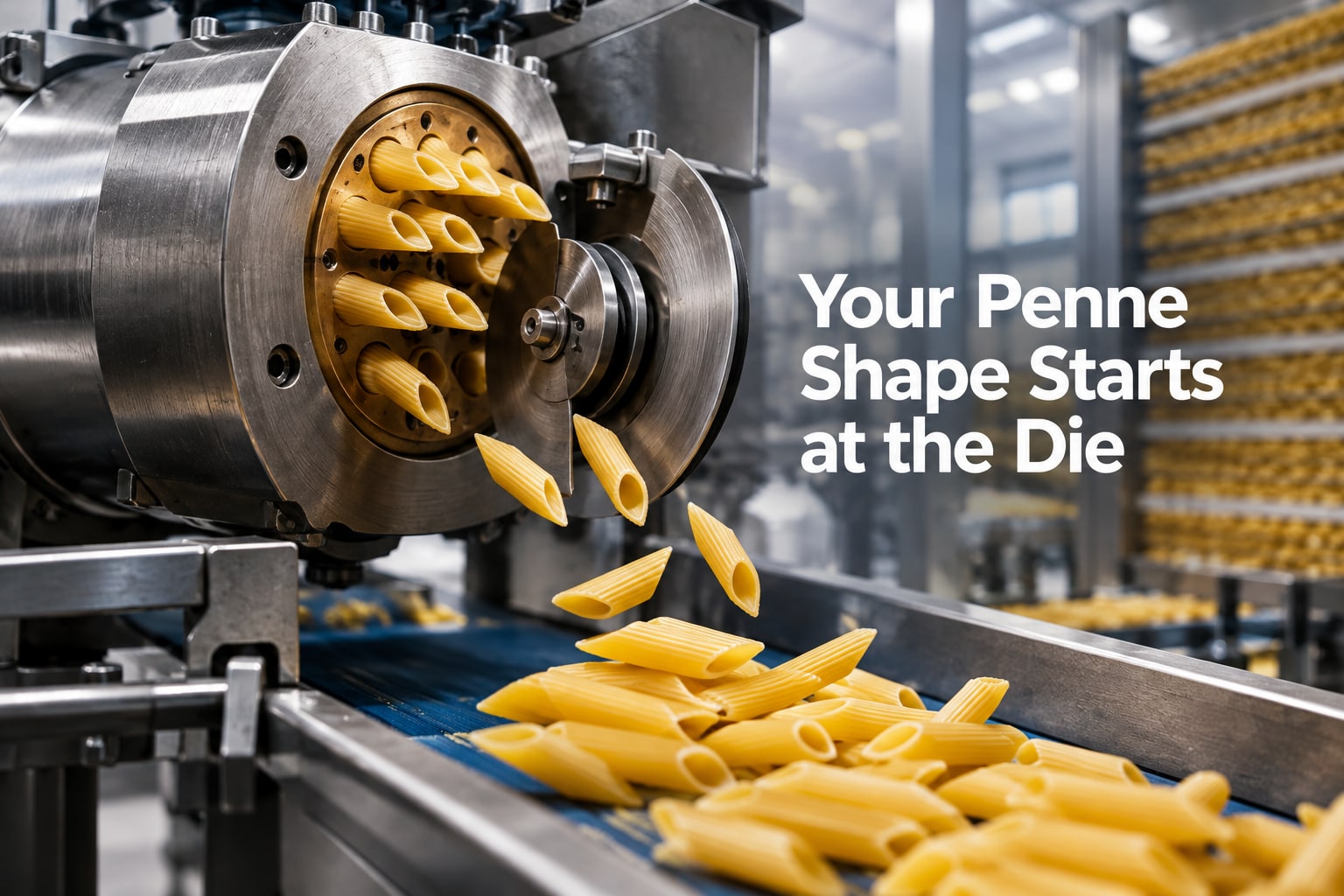
The die and sleeve establish the tube; the cutter establishes its diagonal ends. In a penne production machine, dough passes through an annular die opening around an inner die insert, or mandrel, which fixes bore diameter and wall thickness. The extrusion sleeve supports and sizes the emerging tube before it reaches the knife.
A rotating cutter follows the die face around the tube, while a guillotine arrangement drops or sweeps a blade through it. Blade angle, knife clearance, cutter runout, sharpness and synchronization with extrudate throughput determine whether the cut is clean and consistently diagonal.
| Setting or condition | Visible defect | What is happening |
|---|---|---|
| Cutter too slow | Pulled, stretched or compressed tubes | The extrudate reaches the blade before separation |
| Cutter too fast | Short pieces and fines | The blade cuts too frequently for the throughput |
| Poor knife clearance | Crushed or split ends | The blade presses against the die face or tube |
| Incorrect timing or angle | Long points, blunt ends or variable length | The cut does not meet the moving tube at the intended position |
Unstable feed rate or oscillating pressure produces alternating thick and thin walls; partial die restriction can add flattened tubes and split ends. Excessive line speed gives the cutter less time to separate the tube cleanly and increases ovalising.
Check the pressure trend, mandrel centring and sleeve support before changing knife speed: an eccentric annulus can create one thick wall, bowing and an apparently inconsistent diagonal even with correct timing.
A fault-by-fault penne pasta machine troubleshooting sequence
Use this penne pasta machine troubleshooting sequence when investigating penne pasta machine misshapen pasta for problems: locate the first point where the defect appears, then change one variable at a time.
| Stage | What to inspect | Fault indicated |
|---|---|---|
| After die | Moisture distribution, mixer and barrel temperature, vacuum seal, feed consistency, pressure trend, die cleanliness, die wear and mandrel centring | Rough surfaces, oval openings, thin or thick walls, bowing, missing ridges or closed bores |
| After cutting | Blade sharpness, knife clearance, cutter angle, cutter speed, synchronization and runout | Crushed or split ends, long points, blunt ends or varying lengths |
| After transfer | Conveyor spacing, drop height, pneumatic transport and contact points | Bent, flattened or rotated pieces |
| After drying | Moisture uniformity, temperature gradient, air velocity, loading density and residence time | Cracking, checking, ovalisation or distortion that begins later |
- Collect samples immediately after the die, after cutting, after transfer and after drying. Label each sample with time, line speed, dough batch and machine settings.
- If the tube is already wrong at the die, check dough moisture distribution, mixer and barrel temperature, vacuum leakage, feed consistency, pressure trend, die blockage or wear, and mandrel centring before touching the cutter.
- If the tube is correct but ends are damaged or lengths vary, inspect the cutter in that order: blade, clearance, angle, speed, synchronization and runout.
- If pressure rises and falls, check intermittent feeding, air ingestion, temperature drift and partial restriction before increasing speed.
- Record the original setting, make one correction, run a controlled sample and compare it with the labelled sample. Never change recipe, temperature and speed together.
When the defect begins after extrusion: handling, drying and inspection
A tube that looks correct at the die but becomes oval on the conveyor has a handling defect, not an extrusion defect. Weak surface strength, excessive transfer force, a large drop or unsupported movement can deform fresh penne. If the change begins during pre-drying or drying, investigate moisture and temperature gradients instead.
Rapid surface drying can create case hardening: the outer layer stiffens while the core continues shrinking. The resulting stress causes cracking, checking and locked-in oval or warped shapes.
The same nominal air temperature and residence time can produce different penne pasta shape problems when feed rate, ambient humidity, air velocity, loading density or initial dough moisture changes.
| Stage | What to inspect | Likely meaning |
|---|---|---|
| After die | Diameter, wall and bore | Extrusion, dough, die or mandrel fault |
| After transfer | Ovality, bending and contact marks | Conveyor force, drop height or unsupported movement |
| After pre-drying | Surface cracks and distortion | Moisture or temperature gradient |
| After drying | Final shape, breakage and checking | Uneven moisture removal or excessive shrinkage |
Assess product moisture and moisture uniformity, not air temperature or residence time alone. Set acceptance limits from the product specification and die-maker data, then measure outside diameter, wall thickness, piece length, cut angle, bore openness and breakage rate. Sample at defined intervals and after every die change, recipe change, stoppage or speed change.
Compare results with approved limits; do not invent universal tolerances.
What to require when choosing or upgrading a penne production line
Reject a penne production machine that cannot demonstrate stable pressure and feed rate using your own semolina or flour. Ask for logged temperature readings at the mixer, barrel and die; one temperature display cannot reveal where viscosity and pressure are changing.
Require this commissioning evidence:
- A die-change procedure showing how the insert is centred, measured and inspected for wear, blocked grooves and damage.
- A cutter setup procedure stating blade angle, knife clearance, rotational synchronization with throughput and allowable runout.
- A controlled trial report recording outside diameter, wall thickness, piece length, cut angle, bore openness and breakage rate immediately after cutting and after drying.
- A handling diagram showing how conveyors, transfer points, pre-dryers and dryers support fresh tubes without flattening, rotating or sticking them.
Use the trial results to separate penne pasta extrusion issues from handling faults. A correct die-face sample followed by oval pieces after drying indicates weak post-extrusion support or uneven drying, not automatically a die problem.
| Evidence | What to compare | Disqualifying result |
|---|---|---|
| Pressure and feed log | Stable readings at the approved output | Oscillation or unexplained gaps |
| Die inspection record | Centring and dimensions after each change | No measurement method |
| Shape trial | Before- and after-drying results | No post-dryer data |
Evaluate Khan Engineering and Foods Processing Machine on installation, commissioning, operator training, die changes, process records and fault diagnosis. Automation alone is not the decision; the complete line must hold the approved shape from die face through packaging.
Related products
 | Pasta Machines Khan Engineering’s Penne Pasta Machine: High Efficiency and Precision Khan Engineering offers a state-of-the-art Penne Pasta Machine designed to meet... View product → |
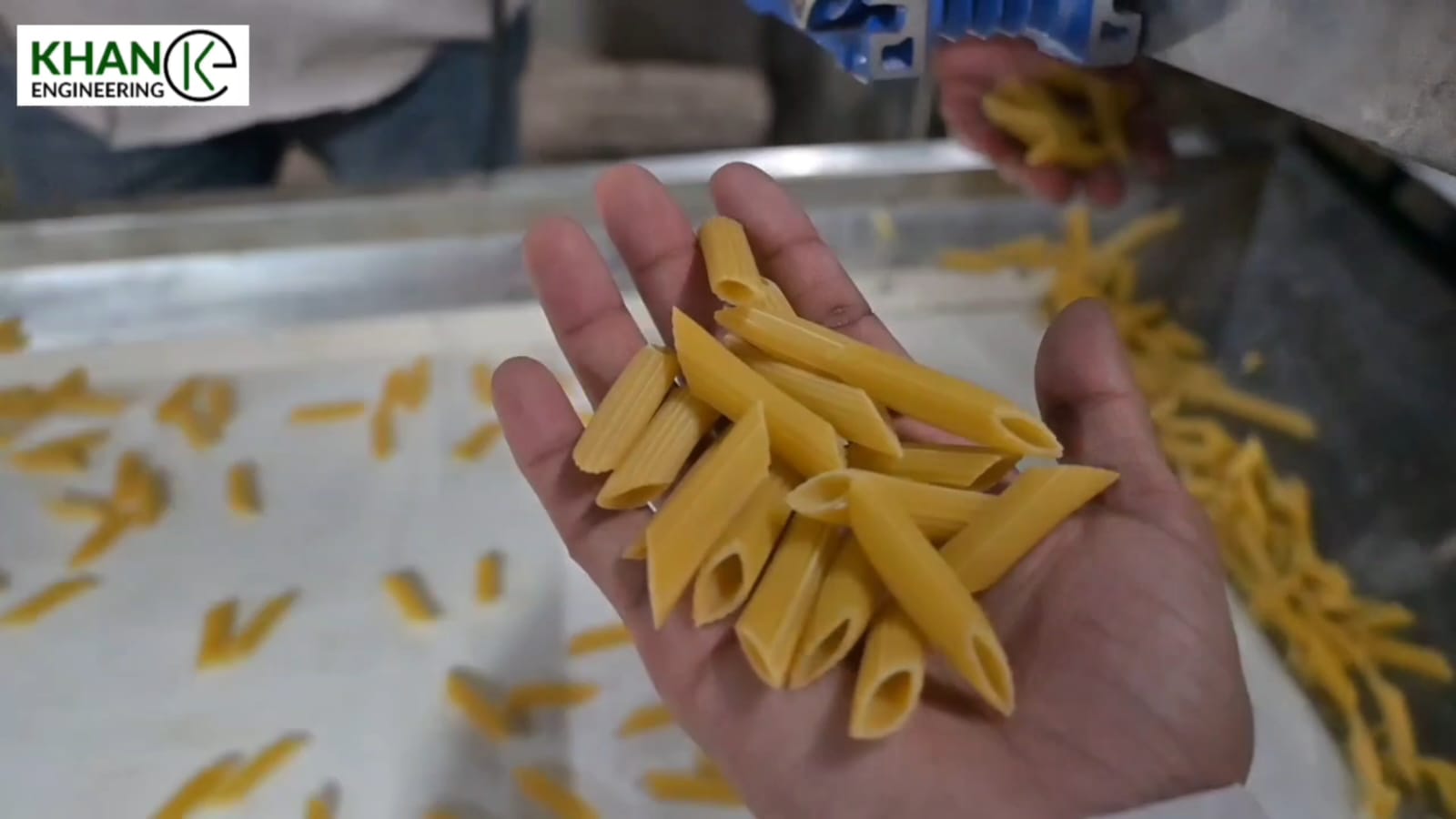 | Pasta Making Machine Khan Engineering’s Penne Pasta Making Machine is a fully automatic and high-performance system designed for commercial pasta production.Built with... View product → |
Frequently asked questions
What causes misshapen penne at the start of production?
Uneven hydration, unsuitable particle size, excessive local moisture and unstable dough flow can create rough surfaces, uneven walls and collapsed tubes before cutting.
How do a die, sleeve and cutter form penne?
The die forms the hollow tube, the sleeve supports the extruded shape, and the cutter produces the tube length and diagonal ends.
What should you check first during penne pasta machine troubleshooting?
Check dough hydration and mixing, then inspect extrusion pressure, die openings, sleeve alignment, cutter condition and cutter timing.
Why can penne become misshapen after extrusion?
Handling, transfer, drying-rate differences and poor inspection controls can deform or crack penne after the cutter has formed it.
What should you require when choosing a penne production machine?
Require documented product trials, recipe and changeover settings, die and cutter specifications, sanitation access, operator training and after-sales service.
Related products
 | Pasta Making Machine Fully Automatic Pasta Making Machine The Fully Automatic Pasta Making Machine simplifies the art of pasta preparation. View product → |
 | Pasta Making Machine The Noodles Pasta Making Machine is a versatile and efficient solution for creating fresh noodles and pasta. View product → |
 | Pasta Extruder Machine The Pasta Extruder Machine is designed for efficient pasta production, offering high-quality and consistent results. View product → |