
A 500 kg rating does not tell you whether the machine accepts 500 kg of wet pasta, produces 500 kg of dried pasta, or holds that amount across its racks. You will be able to trace the batch from loading through moisture removal, equalisation, unloading and cleaning, then identify the measurements and operating settings needed to judge the dryer’s real capacity.
Key takeaways
- Confirm whether 500 kg means wet input, finished output, rack load or chamber capacity.
- Track each batch through loading, conditioning, drying, cooling and unloading.
- Match temperature, humidity and airflow recipes to the pasta shape and thickness.
- Demand capacity, moisture and uniformity test results using your own pasta formulation.
What does the 500 kg rating actually measure?
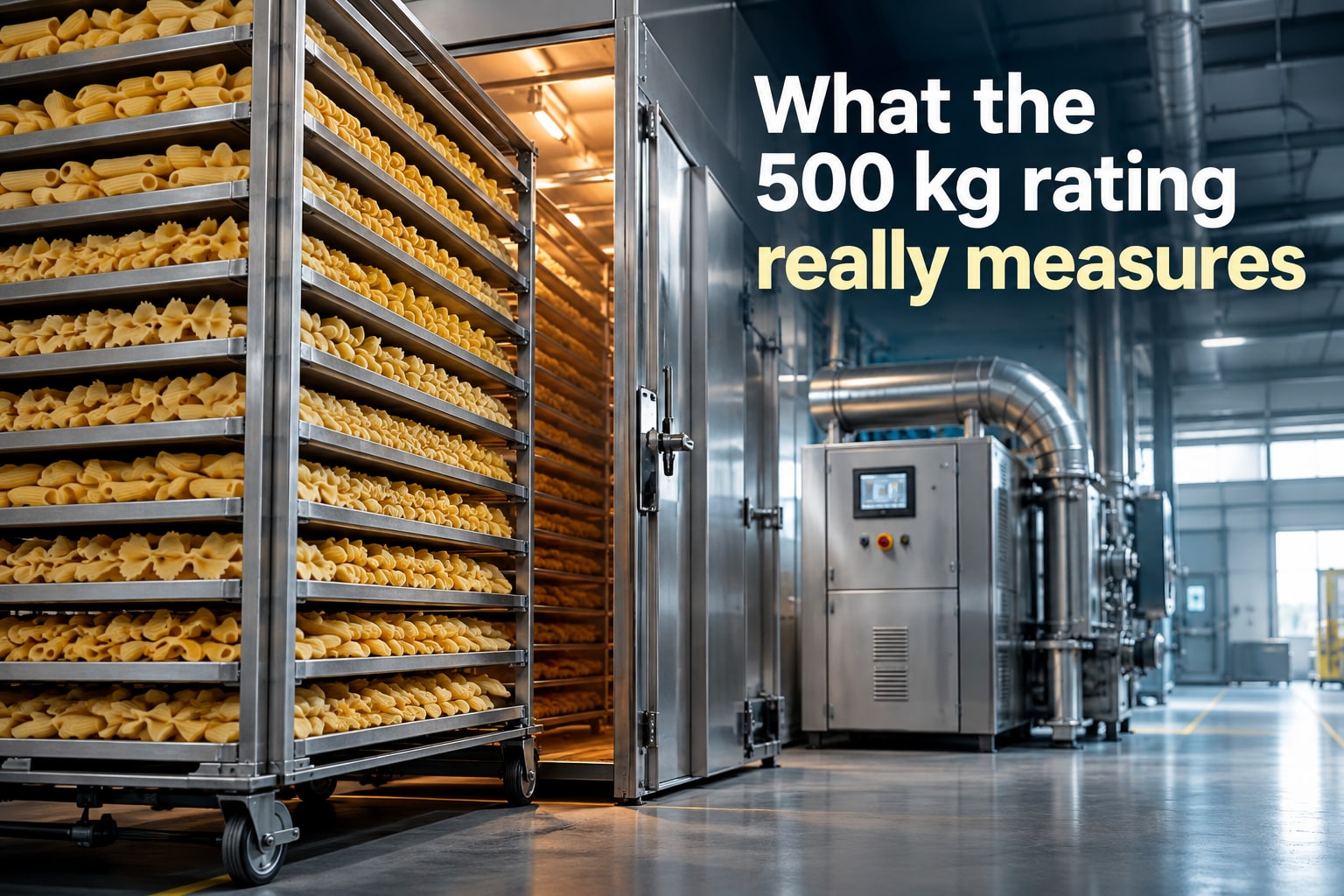
A 500 kg rating is incomplete until you know what the 500 kg includes. It might mean wet dough or fresh-pasta charge entering the chamber, finished dried pasta leaving it, product on the racks, or the chamber’s nominal maximum load. These figures are not interchangeable.
| Supplier’s basis | What 500 kg means | Result |
|---|---|---|
| Fresh charge | Wet dough or pasta loaded | 500 kg at 30% moisture contains 350 kg solids. At 12.5% final moisture, it yields about 400 kg dried pasta after removing about 100 kg water. |
| Higher-moisture charge | 500 kg loaded at 32% moisture | The same solids calculation gives about 389 kg finished pasta. |
| Finished output | Dried pasta leaving the dryer | The required wet charge is greater than 500 kg. |
| Rack or chamber rating | Product load on racks, or nominal chamber maximum | Confirm whether trays, spacing, airflow limits, and usable volume reduce the practical charge. |
The 500 kg pasta dryer’s programmed residence time is not the batch turnaround time. Capacity planning must include loading, rack movement, drying, tempering or equalisation, unloading, and cleaning; otherwise the hourly output will be overstated.
Before comparing machines, request the supplier’s definition of capacity, maximum loading density, accepted final moisture range, and yield basis. Also ask whether the 500 kg static batch pasta dryer process assumes a specific shape, tray arrangement, starting moisture, and measured accepted yield.
How does a batch move through the dryer?
A 500 kg batch begins with shaped pasta loaded onto trays, screens or rack-mounted pans at the specified weight and spacing. The racks enter the chamber, where operators check the door seal, fan, heater, humidity system and safety interlocks before starting the recipe.
1. Initial surface drying removes readily available water from the pasta exterior. Conditioned air circulates around stationary product; the racks do not advance continuously as they would in a belt dryer.
2. Slower internal drying controls moisture migration from the core to the surface. Excessive heat at this point can harden the outside while the centre remains wet, causing cracking, checking or deformation.
3. Final tempering or equalisation lets moisture redistribute through each piece. The operator then cools or tempers the batch as specified before sampling, because a hot sample can misrepresent its final moisture.
4. Operators record the recipe, stage duration, air temperature, humidity, fan or airflow condition and alarms. They unload the racks only after the batch meets the product’s moisture and handling limits.
5. Cleaning completes the pasta drying process. Remove residue from trays, racks, floors, filters and product-contact surfaces before the next load.
A single constant-temperature step is not a complete cycle: it cannot balance rapid surface drying with slower core moisture removal and final equalisation. That staged sequence is what makes a static batch pasta dryer suitable for controlled batch production.
How do temperature, humidity and airflow control drying?
Drying force comes from the difference between moisture in the pasta and moisture in the moving air. Air temperature controls heat transfer and the air’s moisture-holding capacity; relative humidity sets the drying force. High heat with humid air can dry the surface while the centre remains wet, creating case hardening.
- Fan capacity and variable-speed control set air velocity; excessive speed over-dries exposed edges and upper trays, while weak circulation leaves wet pockets.
- Balanced supply and return paths distribute conditioned air across each tray instead of favouring product near an opening, wall or return duct.
- Exhaust-damper position controls how quickly humid air leaves the chamber; excessive exhaust wastes heat, while restricted exhaust reduces drying force.
- Heater size supplies heat but cannot correct poor circulation, so industrial pasta dryer operation depends on fan capacity, balanced ducts and dampers as well.
Set the pasta drying process against loading moisture, dough temperature, tray density, air temperature, relative humidity, fan setting, stage time and final moisture. Start with a controlled stronger condition, then use gentler conditions for internal moisture removal and finish with equalisation.
Heating must stop on fan failure, abnormal temperature, humidity-system failure, an open door, or fire and overheat detection. Otherwise, heating without airflow can damage a local section even when the average chamber temperature looks normal.
Why do pasta shapes need different drying recipes?
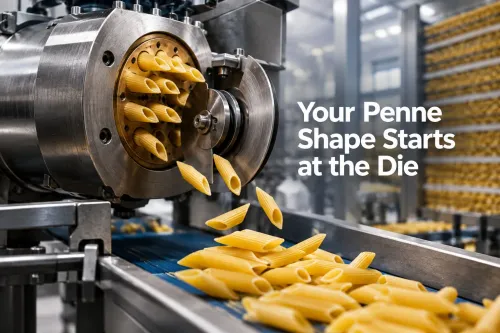
A 500 kg batch of thin short pasta cannot share a recipe with 500 kg of penne because weight does not determine diffusion distance, exposed surface or airflow. Thin pasta dries quickly at its surface; penne and macaroni retain moisture in their thicker walls and around the hollow channel.
Shape also determines how the product sits in the chamber. Spaghetti and other long strands need supports and spacing to prevent sticking, sagging and contact marks. Sheets need flat, even loading to prevent curled edges and trapped moisture, while nests and dense rack loads restrict airflow through the product.
Dough formulation, dough temperature, extrusion pressure and wall thickness change the starting moisture and the resistance to moisture movement. In the 500 kg static batch pasta dryer process, a surface that dries too quickly can form a rigid case over a wet centre, causing internal cracking, checking, deformation or brittle cooked pasta.
Under-drying leaves excessive residual moisture and weakens storage stability.
Use a separate validated recipe for each shape and loading pattern. Record:
- Product moisture at loading and final moisture acceptance limit
- Dough temperature, formulation, extrusion pressure and wall thickness
- Tray loading weight, spacing, nest arrangement and rack density
- Air temperature, relative humidity and airflow or fan setting for each stage
- Initial drying, internal moisture-removal and equalisation stage times
- Cooking-quality checks, including firmness, breakage, sticking and deformation
A static batch pasta dryer must be validated against the product, not just the nominal batch weight.
How do you verify capacity, moisture and uniformity before buying?
A catalogue figure proves only that the chamber accepts a nominal load; it does not prove that a 500 kg static batch pasta dryer will produce saleable pasta from your formulation. Require a witnessed product trial and a written recipe before comparing machines.
- Formulation, starting moisture, dough temperature, shape dimensions and tray loading density.
- Air temperature, relative humidity, airflow or fan setting, exhaust position, stage durations, product-temperature limits and final moisture acceptance range.
Use measured evidence, not an assumed time-and-temperature recipe.
| Evidence | What it proves | Weak substitute |
|---|---|---|
| Trial with your product | Capacity and drying behaviour under defined conditions | Catalogue rating |
| Moisture mapping after cooling or tempering | Uniformity across the batch | One sample from a top tray |
| Accepted-yield and quality report | Saleable output, not merely dried weight | Programmed residence time |
| Turnaround record | Loading, drying, tempering, unloading and cleaning fit plant capacity | Chamber cycle time alone |
Commissioning should record air and product temperatures and product moisture at top, centre, bottom, door-side and wall-side trays after the defined cooling or tempering interval. Commercial dried pasta commonly reaches about 12–13% moisture, but your product specification and applicable standard determine the contractual target; over-drying reduces yield, while under-drying threatens shelf stability.
Also check breakage, sticking, cooking quality, cleaning effort and alarms for fan failure, abnormal temperature, humidity-control loss, door status and fire or overheating. Khan Engineering and Foods Processing Machine can support trials, recipe commissioning and troubleshooting, but judge the industrial pasta dryer operation by recorded results.
Related product
 | Dryers 500 Kg Static Batch Pasta Dryer ₹450000 The Batch Pasta Dryer is a highly efficient solution for drying pasta to perfection. View product → |
Frequently asked questions
What does a 500 kg rating measure on a static batch pasta dryer?
The rating can refer to wet dough input, finished dried pasta output, product held on racks or nominal chamber load. Ask the supplier to define the basis and measurement conditions in writing.
How does a batch move through a static batch pasta dryer?
Operators load pasta onto trays or racks, move the batch into the chamber, run programmed drying stages, cool or condition the product, then unload it for moisture and quality checks.
How do temperature, humidity and airflow control the pasta drying process?
Temperature drives evaporation, humidity controls how aggressively moisture leaves the pasta, and airflow distributes heat and moisture across the chamber. Excessive drying intensity can crack the product or create a dry surface around a moist centre.
Why do pasta shapes need different drying recipes?
Spaghetti, short-cut pasta, filled pasta and thick shapes differ in surface area, thickness and internal moisture travel. Each shape needs a recipe that prevents cracking, sticking, deformation and uneven final moisture.
How do you verify a 500 kg pasta dryer before buying?
Run your formulation and target shape in a witnessed trial. Check actual loaded mass, cycle time, final moisture at multiple rack positions, product uniformity, energy use and damage rate.