
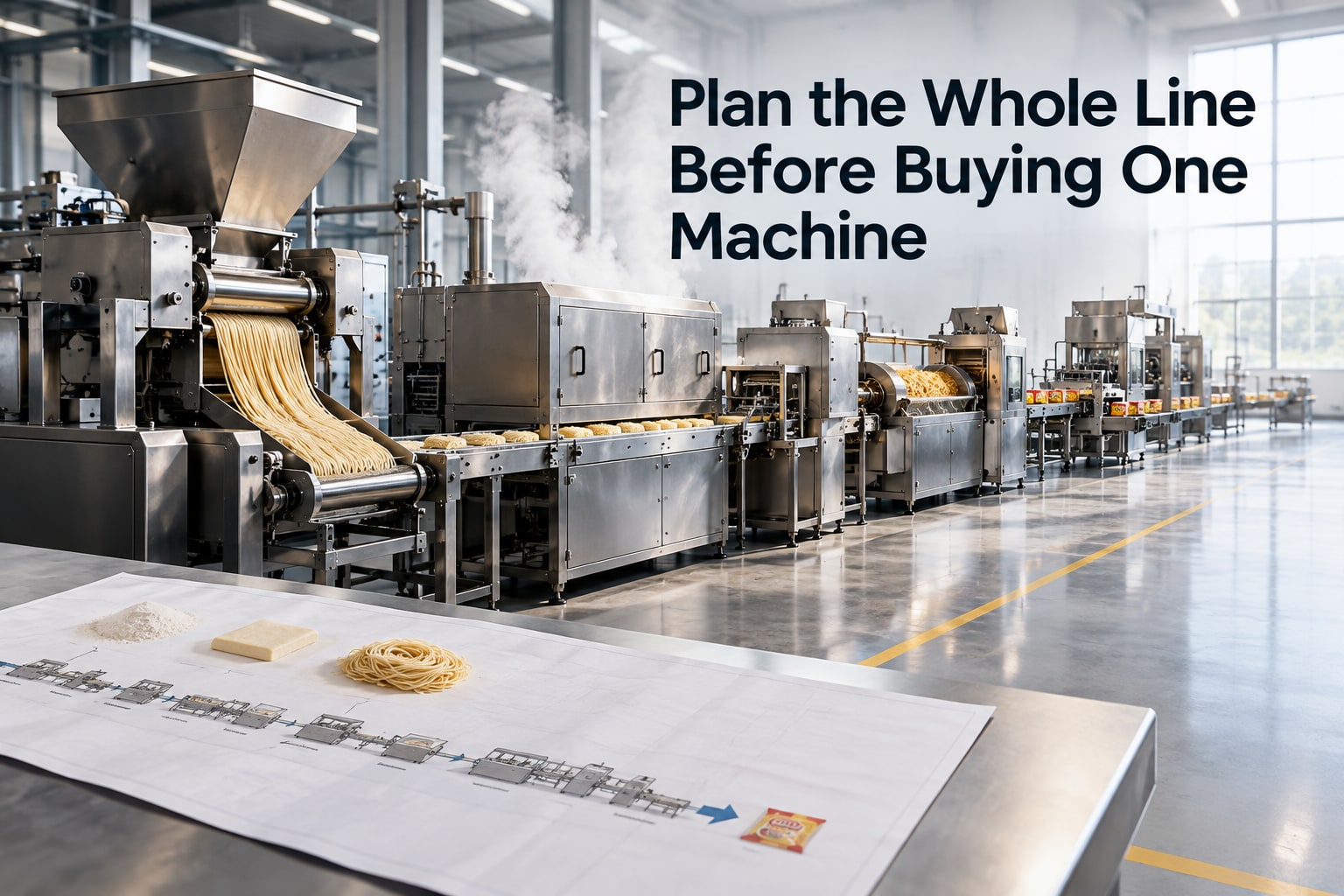
A “Maggi machine” can mean a kiosk cooker that prepares branded-style servings, or a factory line that forms, cooks, dries, seasons and packs noodle cakes. By separating those two purchases, mapping the required process and calculating saleable capacity, you can request comparable equipment instead of relying on an ambiguous machine name or headline kg-per-hour figure.
Key takeaways
- Treat “Maggi machine” as a cooking appliance or a complete manufacturing line.
- Map mixing, sheeting, steaming, cutting, frying or drying, seasoning and packing before comparing quotes.
- Choose line capacity from pack size, shifts, uptime and your sales plan.
- Compare fried and air-dried noodles by oil use, texture, shelf life and operating cost.
What Does “Maggi Machine” Mean in a New Plant?
A “Maggi machine” can mean either a finished-product cooking-and-seasoning unit or a complete instant noodle manufacturing plant. Maggi is a brand name, not a generic machinery category. A restaurant, kiosk, canteen or cloud kitchen usually needs one appliance that cooks noodles and adds seasoning for portions served immediately.
A packaged-food manufacturer needs an instant noodle line that converts flour into noodle cakes, cooks them by frying or hot-air drying, adds seasoning in the required format and seals retail packs.
Maggi machine vs instant noodle line
| Option | Output | Typical buyer | Main scope |
|---|---|---|---|
| Cooking-and-seasoning unit | Prepared servings for immediate consumption | Restaurant, kiosk, canteen or cloud kitchen | Cooking, portioning and seasoning |
| Instant noodle production line | Shelf-stable packaged noodle cakes | Packaged-food manufacturer | Dough processing, steaming, frying or drying, seasoning and retail packaging |
A useful Maggi making machine comparison must separate machinery from intellectual property. Branding, recipe ownership and trademark rights remain separate from the equipment specification; using the Maggi name also requires the appropriate rights.
A quotation titled “noodle machine” may cover only dough forming, such as rolling and slitting. Ask whether it includes steaming, cutting and folding, frying or drying, cooling, seasoning insertion, pouch sealing, date coding, checkweighing and metal detection. Without those named stages, you may be buying a forming machine rather than complete maggi manufacturing equipment.
Map the Full Instant Noodle Production Line Before Comparing Machines
Map the complete instant noodle production line before comparing machine speeds, because a forming machine is only one section of the plant.
- Dose flour and ingredients, mix, rest the dough, compound-roll it, continuously sheet it and slit the web.
- Steam the slit web, then cut and fold it into portions before frying or hot-air drying.
- Cool the noodle cakes, insert seasoning, complete primary packing and pass each pack through metal detection.
Steaming is a process-control stage, not just preheating. Insufficient steaming can leave a hard core after rehydration; excessive steaming can make the noodle web sticky and weak, causing cutting and handling failures.
| Option | Scope | Manual work that remains |
|---|---|---|
| Single machine | Forms noodles | Operators handle dosing, dough preparation, packing and inspection. |
| Semi-automatic cell | Automates forming and cooking | Operators portion cakes, insert sachets and load film. |
| Complete automatic plant | Connects raw-material dosing through case packing | Specify seasoning sachet forming and filling, sachet insertion, date coding, checkweighing and metal detection as separate equipment. |
Do not treat a noodle-forming machine as complete Maggi manufacturing equipment. It may produce noodle cakes but leave you without seasoning control, retail packing, foreign-body inspection or finished cases. A genuine instant noodle production line must show every process section and its utilities in the equipment list.
Choose Capacity From Your Product and Operating Plan
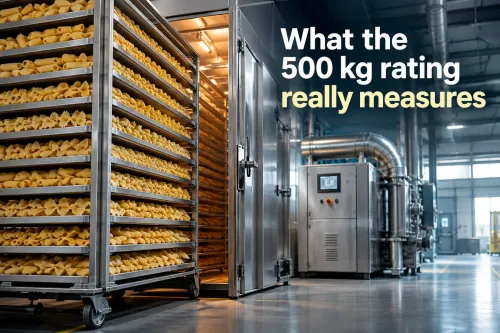
A 120-pack-per-minute rating is not your plant capacity. Calculate net output as:
Finished kilograms = packs/minute × noodle grams/pack × 60 × net operating hours × line efficiency ÷ 1,000.
Net operating hours equal scheduled hours minus planned changeover time. At 120 packs per minute and 70 grams per pack, the line produces 504 kilograms per hour before efficiency and changeover losses.
Use this comparison before selecting an instant noodle production line:
| Parameter | Why it changes capacity | What to specify |
|---|---|---|
| Product format | Cake size and bundle dimensions alter handling speed | Fried or air-dried, noodle width, thickness and cake weight |
| Pack design | Sachet count and pack construction add insertion and sealing work | Pack size, pillow pouch style and number of sachets |
| Operating plan | Shifts and changeovers determine daily saleable output | Hours per shift, changeover duration and planned efficiency |
| Plant resources | Shortages stop a line regardless of its rated speed | Floor area, steam, electricity, compressed air, labour, storage and expansion space |
Two lines rated at 120 packs per minute can produce different kilograms per hour because one may run 70-gram cakes while the other runs 60-gram cakes, or lose time to sachet insertion and changeovers. Packaging often becomes the bottleneck when film registration drifts, powder contaminates seals or sachet timing slows the wrapper.
Ask for guaranteed saleable output at your cake weight, moisture target, seasoning format, pack style and operating schedule, including reject and downtime limits. This is the practical Maggi machine vs instant noodle line test: compare finished product, not the machine’s maximum speed.
Decide Between Fried and Air-Dried Noodle Cakes
Choose fried noodle cakes for rapid moisture removal and a familiar porous bite; choose air-dried cakes for a non-fried product and less oil handling. The wrong choice becomes expensive when the building, utilities, texture target or shelf-life evidence does not match the process.
| Route | Strength | When it is the wrong choice |
|---|---|---|
| Fried | Fast drying and porous texture | You cannot provide filtration, oil replenishment, uniform heating, oxidation or degradation checks, fire protection, exhaust and spent-oil handling. |
| Air-dried | No frying oil and suitable for non-fried positioning | You need fried texture, a compact line or short residence time; drying usually needs a larger section and changes bite and rehydration. |
A useful Maggi machine comparison must examine process conditions, not nominal packs per minute. Request:
- Frying-oil temperature, dwell time, effective heat-transfer area, product loading and target residual moisture.
- Air temperature, humidity or airflow, residence time, cooling time and shelf-life validation.
- Flour input range, noodle width and thickness, steaming temperature and residence time, cutting accuracy and seasoning dosing accuracy.
Include cleaning access, approved sanitation chemicals, drainage and changeover time. Aged or overheated oil can darken cakes and create off-flavours; inadequate air drying can leave poor rehydration or unstable shelf life. Maggi manufacturing equipment is suitable only after the final product defines the route, specification and acceptance tests.
Turn a Supplier Quote Into a Comparable Plant Specification
Reject any quote that gives only a machine name and maximum speed. A comparable specification fixes the product, guaranteed saleable output, utilities, building work and supplier responsibility.
1. Record the product basis: flour type and protein specification, water absorption, dough temperature, resting time, noodle width and thickness, cake weight, target moisture, fried or dried process, packs per minute, pack construction, seasoning format and operating hours.
2. Demand acceptance limits: maximum reject percentage, maximum unplanned downtime, weight tolerance, moisture tolerance, seal-leak rate, seasoning-dose accuracy and metal-detector performance. Test these limits with your intended flour, recipe, film and seasoning.
- Flour and ingredient dosing
- Mixing, resting, sheeting, slitting and steaming
- Frying or hot-air drying, cutting, folding and cooling
- Powder dosing, sachet forming and filling, and sachet insertion
- Pouch or cup feeding, sealing, date coding and checkweighing
- Metal detection and case packing
4. Price the plant, not just the machines: steam generator, steam pressure, condensate return, electrical connected load, process water, compressed-air quality, ventilation and fryer exhaust, drainage, sanitation access, floor space and finished-goods storage. State spare-parts lead time, installation responsibility, commissioning documents and operator-training hours.
5. For India, verify permitted ingredients and additives, label declarations, allergen controls, foreign-body controls and commissioning records against the finished product’s applicable regulations and food-safety system. Ask a noodle machine supplier in Mumbai, including Khan Engineering and Foods Processing Machine, to run trials and define after-sales response.
Related products
 | Maggi Making Machine The Maggi Making Machine is an advanced, high-efficiency appliance designed to automate the preparation of Maggi noodles. View product → |
 | Noodles Making Machine Instant Noodles Making Machine Khan Engineering presents a fully automatic Instant Noodles Making Machine, designed for high efficiency and consistent quality production. View product → |
Frequently asked questions
What does “Maggi machine” mean in a new plant?
It can mean a finished-product cooking-and-seasoning appliance or a complete instant noodle manufacturing plant. Maggi is a brand name, not a machinery category.
What equipment belongs in a complete instant noodle production line?
A full line can include dough mixing, sheeting, slitting, steaming, noodle cutting, portion forming, frying or hot-air drying, cooling, seasoning and packaging equipment.
How should a new plant choose instant noodle line capacity?
Base capacity on pack size, target output, operating shifts, changeover time, expected uptime, labour and the sales plan rather than the machine’s headline speed alone.
Should a new plant choose fried or air-dried noodle cakes?
Compare oil consumption, texture, drying or frying energy, shelf-life requirements, product positioning and the equipment needed for each process.
How can you compare quotations from noodle machine suppliers?
Request matching figures for output, noodle-cake weight, electrical load, steam, compressed air, footprint, utilities, included equipment, installation, commissioning and after-sales support.
Related products
 | Noodles Making Machine Our Noodles Making Machine is designed for efficiency and precision, producing high-quality noodles with minimal effort. View product → |
 | Noodles Extruder Machine The Noodles Extruder Machine is a high-performance equipment designed for producing noodles efficiently. View product → |
 | FOOD PROCESSING MACHINE PASTA, MACARONI MAKING MACHINE PASTA, MACARONI, NOODLES, VERMICELLI, ETC MAKING MACHINE 100KG PER HOUR FULLY AUTOMATIC MACHINE View product → |