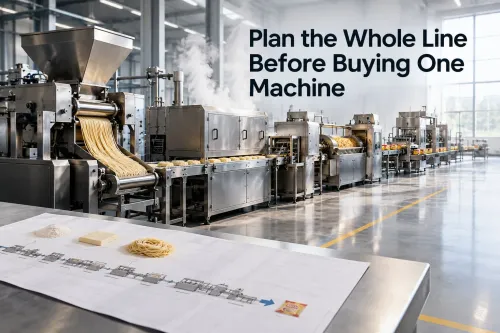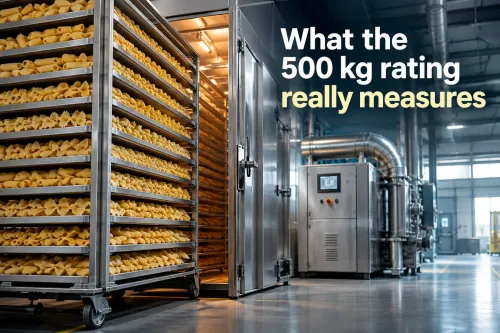


A “500 kg” label does not tell you whether a dryer handles 500 kg of wet dough, finished pasta, tray load or daily output. By defining the capacity, process conditions, utilities, layout and acceptance test first, you can compare Mumbai suppliers on usable performance rather than an attractive nameplate.
Key takeaways
- Define whether 500 kg means fresh load, dried output, rack capacity or daily production.
- Match airflow, temperature and humidity controls to your pasta shape and drying recipe.
- Request utility loads, hygiene details and installation scope before comparing quotations.
- Use a documented acceptance test to compare static batch pasta dryer prices.
Define What 500 Kg Means Before Requesting a Quote
A 500 kg pasta dryer does not necessarily process 500 kg of finished pasta. The figure could mean fresh pasta loaded per batch, dried product discharged, nominal tray or rack capacity, or total production over 24 hours. Confirm the basis before comparing prices.
State these process details in your enquiry:
- Give the feed moisture, target final moisture, batch cycle time, loading density and whether 500 kg means net product weight rather than trays, racks or trolleys.
- Require the quotation to show usable chamber volume, tray or trolley dimensions, tray count, product layer depth and maximum recommended load.
- Ask for performance data from your flour formulation and pasta shape. Heater size or chamber volume alone cannot prove uniform 500 kg performance.
- Use this wording: “Please quote a 500 kg pasta dryer with guaranteed batch input of _ kg fresh pasta, finished output of _ kg at _% final moisture, and a cycle time of _ hours, using our _ flour formulation and _ pasta shape.”
For a 500 kg static batch pasta dryer in Mumbai, define whether the quoted capacity is achieved in one batch or across 24 hours. A static batch dryer keeps product stationary while conditioned air circulates; blocked trays, excessive layer depth and overloading reduce usable capacity.
Require a trial that weighs input and output and samples moisture from top, middle and bottom positions.
Match the Dryer to Pasta Shape, Moisture and Drying Recipe
Suit depends on shape, moisture load and recipe control—not the label 500 kg. A batch pasta drying machine that handles spaghetti can damage nests or filled pasta if airflow, support and drying time are unchanged.
Fresh pasta enters with a higher moisture load than extruded pasta, so provide dough moisture, product dimensions and target final moisture percentage. State whether the 500 kg pasta dryer will process spaghetti, short-cut or filled formats.
| Format | Arrangement and thickness | Airflow and drying implication |
|---|---|---|
| Spaghetti | Long, thin strands on rods or hanging frames | Controlled, low-to-moderate velocity; longer, even drying |
| Macaroni | Hollow short pieces on perforated trays | Moderate velocity; avoid blocking tube openings |
| Penne | Short, thicker diagonal tubes on trays | Moderate velocity; longer than thin shapes |
| Nests | Coiled strands on trays or nest supports | Low velocity; protect shape and allow interior access |
| Sheets | Broad, flat layers on trays | Low velocity; prevent edge curling and surface drying |
| Filled pasta | Ravioli or similar pieces on trays | Low velocity; protect seals and filling; longest, gentlest recipe |
Use staged drying, not one constant temperature. Early aggressive moisture removal can harden the surface while the centre contracts, causing cracks or deformation; insufficient drying leaves high residual moisture and weak shelf stability.
Request the operating temperature and relative-humidity ranges, airflow rate, fan capacity, fresh-air and exhaust method, air-change rate, independent zones, sensor locations, control accuracy and recipe-recording capability. A temperature-only hot-air cabinet cannot match a system that controls humidity, fan speed and exhaust ratio.
Specify Utilities, Hygiene and Mumbai Installation Requirements
Before a site visit, require a utility schedule, hygienic-design specification and layout drawing. A static batch pasta dryer price is incomplete without these documents.
1. Name the heating medium: electric resistance, steam, thermal oil, LPG, natural gas, hot water or heat pump. State connected electrical load, fuel consumption or steam demand, compressed-air demand, exhaust-air discharge, condensate drainage and recovery time between batches.
2. Give the building data: overall dimensions, usable tray area, rack count, loading height, door clearance, trolley route, maintenance clearance, floor load and foundation requirements. Mark every connection and service zone on the drawing before committing.
3. Specify stainless-steel grade, insulated-panel thickness, internal weld finish, food-contact surfaces, gasket material, drains, inspection access and cleanability. Use ISO 14159 and EN 1672-2 as hygienic-design benchmarks, then confirm the Indian requirements governing the installation.
4. Document dust and heat controls: grounding and bonding, motor and fan suitability, over-temperature cut-outs, emergency stops, electrical-panel protection, dust-cleaning access and fire detection or suppression where required. Require the supplier to record the hazardous-area classification and explosion-protection decision instead of leaving it unstated.
Give the pasta dryer supplier in Mumbai a site plan showing exhaust discharge, drainage, utility entry, trolley movement and heat rejection. Reject a quote that omits the layout, floor-load data or cleaning access; those omissions become expensive civil changes after delivery.
Choose a Mumbai Supplier That Can Commission the Process
Choose a pasta dryer supplier in Mumbai that owns installation, commissioning and process support, not one that only delivers a cabinet. Tray position, fan balancing and humidity-sensor calibration affect moisture uniformity. For Khan Engineering and Foods Processing Machine, request a site-specific layout, utility schedule, installation scope and a reference handling comparable pasta format and load.
Ask for written commitments covering:
- PLC and HMI backup, spare heaters, fans, sensors, seals and drives, breakdown response time and warranty duration.
- Operator training, preventive-maintenance intervals and calibration or process revalidation after sensor replacement.
- A product trial using your flour formulation, dough moisture, pasta geometry, loading pattern and packaging target.
For a 500 kg static batch pasta dryer in Mumbai, compare supplier evidence before comparing price:
| Evidence | What to verify | Failure it prevents |
|---|---|---|
| Trial report | Inlet/outlet air, moisture at multiple tray positions, cycle time, energy, breakage and rejects | Uneven drying and unproven capacity |
| Service plan | Spare stock, response time, warranty and maintenance schedule | Extended production stoppage |
| Documentation | PLC/HMI backup, calibration and revalidation procedure | Lost recipes or unreliable readings |
Also verify FSSAI-related sanitation duties: cleaning records, pest control, water quality and personnel hygiene. Equipment supply does not transfer those duties from your food business. Require the supplier to state how operators will clean the dryer and document each sanitation check.
Related product
 | Dryers 500 Kg Static Batch Pasta Dryer ₹450000 The Batch Pasta Dryer is a highly efficient solution for drying pasta to perfection. View product → |
Compare Static Batch Dryer Prices Using an Acceptance Test
A static batch pasta dryer price is worth comparing only after you receive an itemised commercial offer for the complete installation.
- Chamber, trays or trolleys, heater, fans, humidity hardware, PLC/HMI, sensors and insulation
- Exhaust ducting, electrical panel, installation, commissioning, freight to Mumbai, taxes and civil works
- Operator training and optional automation, including recipe storage, automatic humidity control and data logging
Compare the batch pasta drying machine by energy consumed per kilogram of finished pasta, not by purchase price alone. Two 500 kg machines can have different running costs because of heating medium, insulation quality, fan power and cycle time.
| Acceptance measure | What to record | Failure consequence |
|---|---|---|
| Final moisture | Top, middle and bottom racks | Uneven shelf stability |
| Repeatability | Results across consecutive batches | Unreliable production planning |
| Cycle and restart time | Drying duration and recovery between batches | Lost output between batches |
| Breakage and recovery | Broken product and saleable finished weight | Higher waste and lower yield |
Require a signed trial report using your flour formulation, dough moisture, pasta shape, loading pattern and target recipe. An empty-chamber temperature test or unrelated pasta trial proves nothing about production performance.
Reject or renegotiate if the supplier cannot state the guaranteed load basis, final moisture range, utility demand, test method and remedy when results fall outside those values. Include product recovery and maximum breakage in the signed acceptance criteria.
Frequently asked questions
What does 500 kg mean when buying a pasta dryer?
Confirm whether 500 kg refers to fresh pasta loaded per batch, dried pasta discharged, tray or rack capacity, or 24-hour production.
How should you match a batch pasta drying machine to your product?
Specify pasta shape, dimensions, moisture targets, loading method and the temperature, airflow and humidity stages required by your drying recipe.
What should you confirm before installing a pasta dryer in Mumbai?
Ask for electrical load, steam or hot-water requirements, exhaust and drainage needs, food-contact materials, cleaning access and the installation scope.
How can you compare static batch pasta dryer prices?
Give each supplier the same product and process brief, then compare cycle time, energy use, controls, included installation and results from a written acceptance test.