
The investment only makes sense when saleable packed kilograms, not the supplier’s headline capacity, cover the machine, utilities, labour, oil, packaging and downtime. You will be able to test that calculation, map the equipment and staffing required, and decide whether a standalone machine or complete line fits your Mumbai operation.
Key takeaways
- Calculate payback from saleable packed output, not machine nameplate capacity.
- Map extrusion, frying, seasoning, cooling and packing before comparing quotations.
- Check power, water, compressed air, drainage and ventilation at your Mumbai site.
- Match automation with staffing, cleaning needs and planned production hours.
Calculate the payback from saleable packed output
A kurkure making machine for snack manufacturers in Mumbai is worthwhile only if its saleable packed output creates enough annual contribution to recover the installed cost. Calculate payback as:
Installed line cost ÷ annual incremental contribution
Use packed kilograms that pass seasoning, metal detection and seal checks—not the extruder’s rated kilograms per hour.
Put these figures into the model:
- Saleable kg per hour after frying, cooling, rejects and changeovers
- Planned operating hours per year, including cleaning and maintenance downtime
- Net selling price per packed kilogram
- Cornmeal, oil, seasoning and packaging cost per kilogram
- Labour cost saved, added power and fuel cost, maintenance and spare parts
- Installation, utilities, commissioning and operator-training costs
Annual contribution equals saleable kilograms multiplied by selling price, minus variable costs, plus genuine labour savings. Include oil and seasoning losses; a line that consumes more oil per saleable kilogram can erase its apparent throughput advantage.
Run the calculation at your actual schedule. A line that pays back in three shifts may fail to justify its capital cost at one shift, especially after Mumbai utility constraints, cleaning time and downtime reduce annual output.
Ask for a guaranteed packed-output trial using your recipe, die, frying temperature and pack format before accepting the supplier’s capacity figure.
Map every process stage before comparing quotations
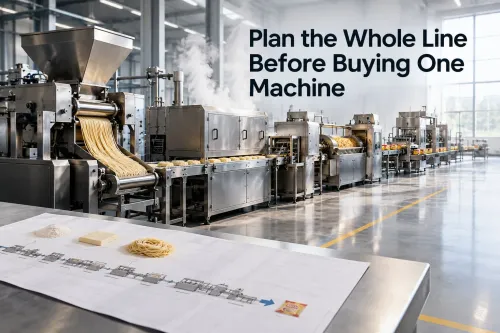
A complete Kurkure line requires more than an extruder: it must move, cook, fry, finish, cool and pack the product without creating bottlenecks or manual handling gaps. Draw the material flow before comparing any quotation for a kurkure production machine.
- Confirm raw-material handling for cornmeal, starch, seasoning ingredients and water, including weighing, mixing and controlled feeding.
- Specify the cooker-extruder, die geometry, screw configuration and cutter. These determine expansion, wall thickness, curl length and breakage.
- Include frying equipment with oil heating, filtration, temperature control and a defined method for removing excess oil.
- Add seasoning equipment, dosing controls and a cooling conveyor. Packing hot or damp snacks increases seal faults and shortens shelf life.
- Match the packaging machine to usable fried output, with film tracking, date coding, metal detection and seal inspection.
- Require nitrogen flushing only as part of the packing system. It reduces headspace oxygen, but cannot fix leaking seals, poor moisture-barrier film, residual moisture or inadequate cooling.
Ask the supplier to identify which conveyors, elevators, hoppers, exhaust connections, compressors and utilities are included. A quotation calling the extruder an “automatic Kurkure making machine” can still leave frying, seasoning, cooling and packing as manual operations. Get sample runs using your formulation and target shape before accepting the process map.
Separate rated capacity from saleable output
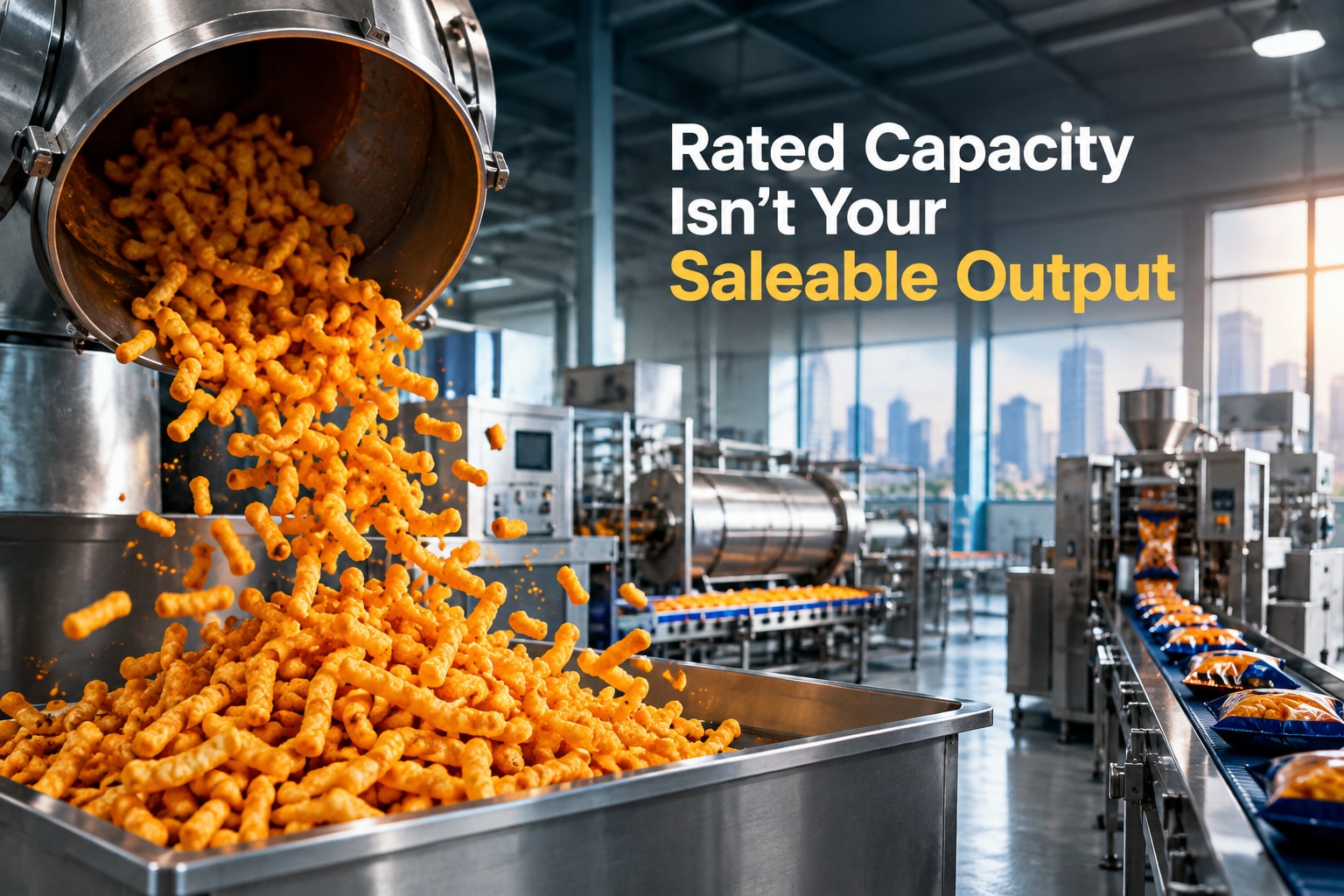
Compare an automatic kurkure making machine on saleable packed kilograms per hour, not the largest number in the quotation. Rated capacity depends on the die, formulation, input moisture, product size and operating speed; a figure for wet extrudate is not equivalent to fried or packed output.
| Item | Quotation figure to request | Use in the decision |
|---|---|---|
| Rated capacity | Wet extrudate, fried product and packed product, each in kg/h | Reject comparisons that mix different measurement points |
| Saleable output | Packed kg/h after breakage, oil loss, seasoning giveaway and rejected seals | Multiply this by your planned operating hours |
| Run length | Continuous hours before refill, adjustment or stoppage | Check whether the line suits your shift and order pattern |
| Changeover | Minutes to change die, cutter, seasoning and pack size | Include lost production between products |
| Cleaning | Minutes to dismantle, wash, dry and inspect food-contact parts | Add this downtime to every production day |
Ask for a trial using your corn-grit specification, finished moisture, shape, oil, seasoning load and pack size. Record saleable packs, breakage, oil uptake, seasoning loss and seal rejects during the trial.
A line rated for three shifts can look productive while earning nothing on one shift. Compare labour and utility cost per packed kilogram after changeovers and cleaning, then require those conditions in the performance guarantee.
Check Mumbai site utilities before choosing the line
A kurkure machine in Mumbai can fit your floor plan and still miss its promised output if the building cannot supply stable power, heat, airflow, drainage or compressed air. Confirm these services before accepting the quoted kilograms per hour.
| Service or condition | Capacity limit | What to verify |
|---|---|---|
| Electrical supply | Voltage drops trip drives, heaters and packers, forcing stoppages | Connected load, phase balance, cable size, generator capacity and backup changeover |
| Heating fuel | Insufficient gas pressure or fuel flow slows cooking and frying | Fuel type, regulator capacity, storage, burner demand and fire-safety clearance |
| Exhaust and make-up air | Poor extraction raises heat and humidity, while negative pressure disrupts burners | Canopy size, duct route, discharge point and replacement-air openings |
| Drainage and wastewater | Oil, wash water and starch can block drains or breach discharge limits | Floor slope, trapped drains, grease interception and approved wastewater disposal |
| Compressed air | Low pressure causes cutter, valves and packaging controls to misfire | Compressor flow, receiver volume, filtration, dryer and peak demand |
Check maintenance access around the extruder, fryer, de-oiler and packer; a cramped line loses hours during cleaning and repairs. Ask for critical spare-parts lead times, especially heaters, drives, sensors, dies, cutters and sealing components.
Finally, demand capacity tests using your formulation, die, moisture level and target speed. Record wet extrudate, fried product and saleable packed output separately, because a utility-constrained line can produce a very different result from its nameplate rating.
Specify the equipment around quality, cleaning and control
A consistent, economical line depends on fryer control, seasoning accuracy, cleanability and pack-seal feedback—not the word “automatic” in a quotation. Kurkure plant equipment should let operators control feed moisture, extrusion pressure, cutter wear, frying temperature and residence time.
| Specification | What it controls | Ask for |
|---|---|---|
| Continuous fryer with uniform heating, adjustable residence time, filtration, crumb removal and de-oiling | Crispness, darkening and oil uptake | Oil volume, temperature range, filtration method and heat recovery |
| Oil-monitoring and segregation arrangement | Legal oil control and replacement cost | Total polar compounds testing against the 25% FSSAI limit, plus disposal or reuse records |
| Seasoning drum with metered powder feed, product-temperature control and dust extraction | Flavour distribution and net weight | Feed-rate range, residence-time adjustment and cleanout access |
| Tool-less opening, sloped surfaces, drain points and removable contact parts | Sanitation time and contamination risk | Cleaning procedure, washdown limits and estimated changeover duration |
| Multihead weigher, metal detector, checkweigher and vertical form-fill-seal machine | Pack accuracy, foreign-body control and seal quality | Reject confirmation, seal-temperature range, leak testing and film specifications |
- saleable kilograms per hour
- oil loss per packed kilogram
- cleaning and changeover minutes
- rejected packs and seal failures
Automation reduces repetitive labour, but operators still control moisture, oil quality, seasoning pickup and seals. A line that cannot expose those controls will hide variation rather than remove it.
Match automation to your operation and staffing plan
An automatic Kurkure making machine benefits manufacturers with steady demand, long production runs and enough packed volume to keep the line occupied. It suits plants replacing repetitive manual work, not businesses running occasional small batches; one shift of output may not repay a line sized for three.
| Operation | Automation fit | Staffing test |
|---|---|---|
| Steady multi-shift production | High | Keep operators for feed moisture, extrusion, frying, seasoning, packing and quality checks |
| Growing one-shift production | Conditional | Confirm labour savings and saleable kilograms per hour cover the capital cost |
| Short runs and frequent recipes | Low | Price changeover, cleaning and extra supervision before choosing automation |
A Kurkure machine in Mumbai must also fit your utilities, maintenance access and available operators. Automation reduces handling; it does not remove process skill.
Before accepting a performance guarantee, demand a signed trial or acceptance test that states:
- Formulation, corn-grit specification, input moisture, finished-product moisture, shape, size and cutter setting
- Frying-oil type, temperature range, seasoning load and oil-uptake limit
- Saleable kilograms per hour, run length, breakage, giveaway, rejects and pack size
- Cooling time, residual moisture, seal integrity and nitrogen-flush verification when specified
- Operator count, changeover duration, cleaning time, connected load and permitted downtime
Ask Khan Engineering and Foods Processing Machine, and every competing supplier, to quote packed saleable output rather than extruder capacity. Reject a guarantee that omits these conditions; it cannot prove what you will actually produce.
Related product
 | Kurkure Making Machine The Kurkure Making Machine is designed for producing crispy, crunchy snacks like Kurkure with high efficiency. View product → |
Frequently asked questions
How do you calculate payback for a kurkure machine?
Divide the installed project cost by annual contribution from saleable packed output. Base the calculation on actual packed, accepted product rather than rated capacity.
What process stages should a kurkure production machine quotation include?
Map and compare extrusion, cutting, frying, seasoning, cooling, conveying, weighing, packing and related utilities before accepting a quotation.
Why does rated capacity differ from saleable output?
Rated capacity describes equipment throughput under stated conditions. Saleable output also accounts for start-up losses, rejects, moisture variation, downtime, cleaning and packing performance.
Which Mumbai site utilities must you check before choosing kurkure plant equipment?
Confirm available electrical load, water supply, drainage, compressed air, ventilation and exhaust capacity before selecting the line.