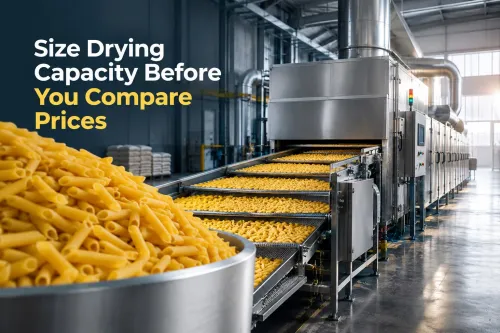

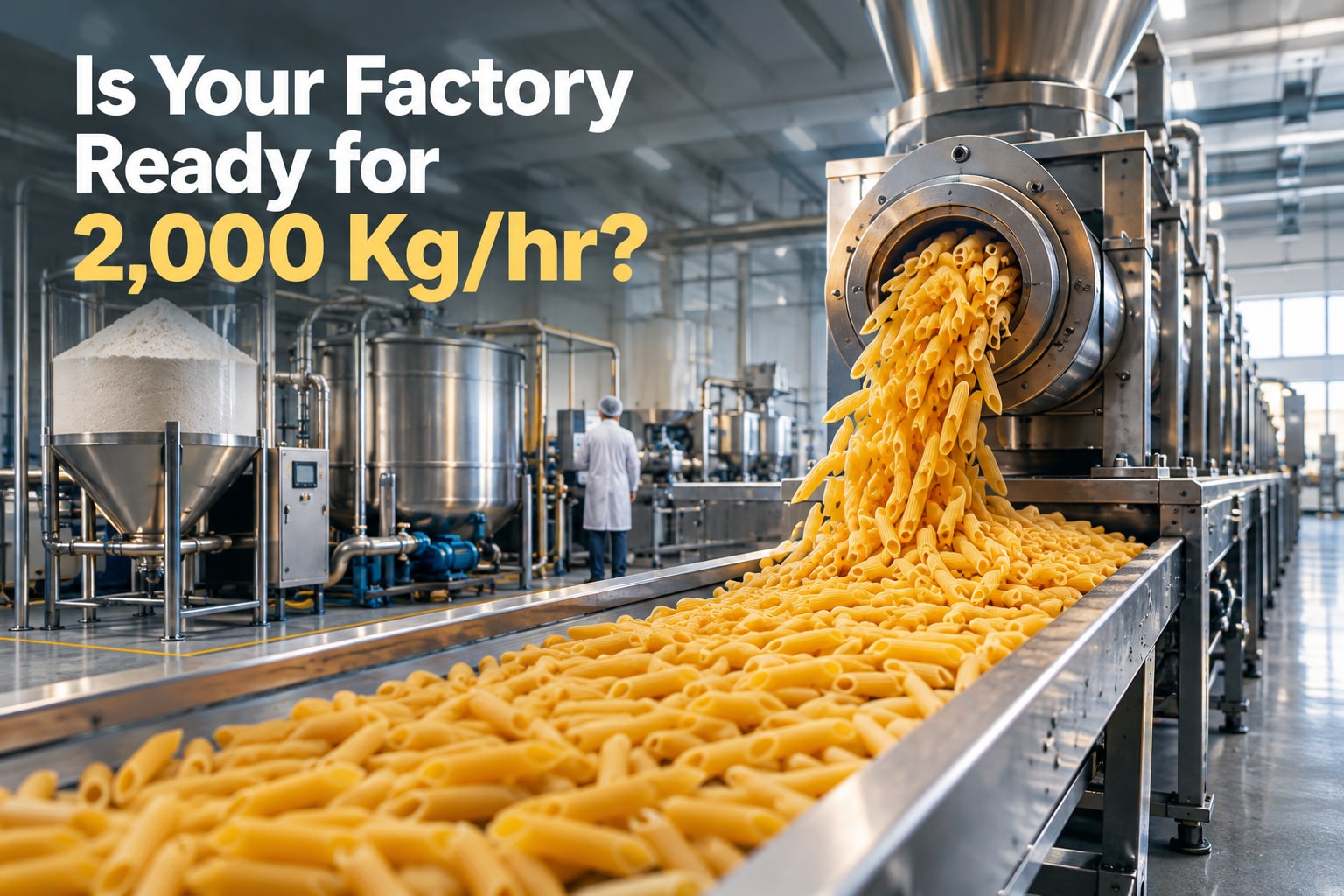
A quoted 2,000 kg per hour does not tell you whether a supplier can deliver 2,000 kg of saleable dried pasta from your chosen recipe, shape and site. You will be able to identify a credible Noida supplier, test the capacity claim, prepare your factory and decide whether this line is more sensible than a 100, 200 or 500 kg/hr alternative.
Key takeaways
- Verify the supplier’s address, installation coverage and service team before requesting a quotation.
- Ask whether 2,000 kg/hr means fresh dough input, finished pasta output or peak capacity.
- Confirm included dies, shapes, dryers, conveyors, packaging equipment and changeover requirements.
- Check power, water, compressed air, floor space and drying-room needs before ordering.
How to Locate and Qualify a Noida Supplier
Start with a local search for a 2000 kg per hour pasta machine in noida, then verify the supplier’s physical address, factory or showroom, delivery coverage and installation location. Treat a catalogue listing as a lead, not proof of capacity or service capability.
1. Ask whether the seller is an industrial pasta machine manufacturer or an authorised integrator. Request a factory visit, line layout, company registration details and the names of engineers who will supervise installation in Noida.
2. Require a complete equipment schedule covering flour and water dosing, mixing, vacuum extrusion, cutting, pre-drying, final drying, cooling, conveying, weighing and packing. The quotation must separate machinery, freight, installation, commissioning, training, taxes, civil foundations, utility piping, insulation, ducting and after-sales visits.
3. Demand a written capacity basis for each product: dough input, wet pasta output or finished dried-pasta output. Record the recipe, raw-material moisture, die diameter, operating speed and finished-product moisture; drying removes substantial water, so these figures are not interchangeable.
4. Request at least two references producing comparable volumes and shapes. Ask those operators about sustained output, dryer stability, die availability, PLC support, spare-part lead times and post-commissioning response.
5. Check machine drawings, electrical safety records, guarding, food-contact materials and the certifications required by your insurer, export market or engineering standard. FSSAI licensing applies to the food business operating the plant, not automatically to every machine supplier.
Reject a seller who offers only an extruder or refuses a site survey, performance test and written responsibility for installation, commissioning and operator training.
What the 2,000 kg/hr Capacity Figure Really Measures
The 2,000 kg/h figure is meaningless until the supplier identifies where mass is measured. Treat a quote from a 2000 kg hr pasta machine supplier as a production-line claim, not proof that 2,000 kg of saleable dried pasta leaves the packing machine every hour.
| Basis | What the figure measures | Why it changes the comparison |
|---|---|---|
| Dough input | Flour, water and other ingredients entering the mixer or extruder | Includes water that later evaporates |
| Wet pasta output | Shaped pasta leaving the extruder or pre-dryer | Still contains process moisture and may shrink during drying |
| Finished dried pasta | Cooled, specification-compliant pasta ready for packing | The figure reflects drying losses, rejects and saleable output |
Request a signed capacity sheet for every intended product, not one headline number. It must state:
- Flour and water moisture, recipe, dough temperature and feed rate
- Shape, die diameter, cutter setting and operating speed for macaroni, penne, fusilli and spaghetti
- Finished moisture target, continuous test duration and actual net kilograms packed
- Breakage, rejects, product dimensions, cooking loss and electricity, steam, gas or compressed-air consumption
A large scale pasta production machine should be rated across the complete route: dosing, mixing, vacuum extrusion, cutting, pre-drying, final drying, cooling and packing. “Maximum capacity” recorded briefly at the extruder is not finished output.
Ask for a continuous acceptance test under your recipe and require the contract capacity to mean saleable dried pasta, unless the quotation clearly defines another basis.
Which Line, Shapes and Dies Are Included
A complete 2,000 kg/h line is an integrated system, not a standalone extruder. A large-scale pasta production machine should include flour and water dosing, mixing, vacuum extrusion, cutting or spreading, pre-drying, final drying, cooling, conveying, weighing and packing.
Ask the supplier to state rated output for every shape at the same defined conditions: recipe, raw-material moisture, die diameter, operating speed and finished-product moisture. A “2,000 kg/h” claim is incomplete if it describes dough feed rather than saleable dried pasta.
| Product | Required forming equipment | Downstream details to confirm |
|---|---|---|
| Macaroni | Tubular die and automatic cutter | Short-cut spreading, pre-dryer and dryer settings |
| Penne | Penne die and angled cutter | Cut length, diagonal quality and reject rate |
| Spaghetti | Long-goods die, spreader and rod-loading system | Hanging or rod transfer, long-goods dryer and breakage |
| Fusilli | Spiral die and controlled cutter | Spiral pitch, length consistency and anti-sticking handling |
| Shells | Shell die and short-cut cutter | Cavity definition, spreading and drying uniformity |
| Specialty shapes | Named die set for each SKU | Tooling cost, availability and verified trial output |
For a high capacity pasta machine in Noida, require the quoted changeover time for dies, cutters, rods and dryer recipes. The acceptance test should record sustained net output, finished moisture, dimensions, breakage, cooking loss and utility use after drying and packing—not a brief extruder maximum.
How to Prepare the Factory for a High-Capacity Line
Before ordering, freeze the site plan against the supplier’s general-arrangement drawing, utility schedule and equipment weights. A high-capacity pasta machine in Noida can fit on paper yet fail at installation if the dryer, packing section or maintenance access is missing.
1. Ask the 2000 kg hr pasta machine supplier to specify, for each SKU, connected electrical load, voltage, phase, frequency, compressed-air pressure and consumption, process-water flow and quality, heating fuel or steam demand, exhaust volume and cooling requirements. Separate running load from peak load.
2. Confirm the complete footprint from flour dosing through packing, plus operator aisles, control-panel access, die removal space and dryer maintenance clearance. Measure building length, clear height, door width, turning radius, loading-bay height and the route from truck to foundation; check whether the tallest dryer section can pass beneath beams.
3. Obtain foundation drawings showing slab thickness, anchor-bolt positions, point loads, vibration limits and floor level tolerances. Do not pour concrete from a sales sketch.
4. Provide trapped floor drains beneath mixing, extrusion, pre-drying, cooling and washdown zones. Confirm slope, drain capacity, hot-water disposal, condensate routing and separation from finished-product areas.
5. Reserve enclosed areas for flour and additives, packaging film, dies and inserts, spare parts, work-in-progress and finished cartons. Control humidity and pest access, and leave forklift lanes clear.
Khan Engineering and Foods Processing Machine should mark every connection, load and service clearance on the final layout before civil work begins. Get installation, ducting, piping, foundations and commissioning shown as separate quotation lines.
Related product
 | Pasta Machineries 2000kg/hr Pasta & Macaroni Making Machine – Industrial-Scale Production with Precision Khan Engineering’s 2000kg/hr Pasta Making Machine is a fully... View product → |
When 2,000 kg/hr Beats a Smaller Machine
A 100 kg/hr line suits trials, local orders and several small production runs; 200 kg/hr adds useful headroom without committing to a full plant. At 500 kg/hr, labour per tonne falls, but dryer, packing and storage must keep pace.
A 2,000 kg per hour pasta machine in Noida earns its cost only when demand can absorb sustained output.
| Option | Output and staffing | Utilities and changeovers | Capital risk and saleable production |
|---|---|---|---|
| 100 kg/hr | Lowest output; more labour per tonne and frequent supervision | Lowest flour, water, power and drying demand; fastest format changes | Lowest exposure; saleable output is practical for short runs and varied SKUs |
| 200 kg/hr | Doubles output without multiplying operators; suitable for regional distribution | Moderate dryer and packing demand; changeovers still manageable | Moderate investment; rejects remain easier to isolate |
| 500 kg/hr | Stronger economies of scale; fewer operators per tonne, but skilled line coverage is essential | Higher steam or electric drying load, compressed air and exhaust; format changes can interrupt more kilograms | Higher commitment; saleable output depends on stable drying and packing |
| 2,000 kg/hr | Highest throughput; staffing shifts toward automation, quality control and maintenance | Large integrated utilities and longer cleanout, die and cutter changeovers | Highest capital and demand risk; accept only against sustained net output after drying, rejects and packing |
Ask an industrial pasta machine manufacturer for SKU-specific runs, not an extruder’s brief peak. Verify dough input versus wet or finished dried pasta, then measure moisture, breakage, cooking loss, energy use and packed tonnes during continuous operation.
A 2,000 kg/hr line beats a smaller machine when those saleable figures support the order book and dryer utilisation.
Frequently asked questions
How do you qualify a 2,000 kg/hr pasta machine supplier in Noida?
Confirm the supplier’s physical address, factory or showroom, delivery coverage, installation location and after-sales service. Treat a catalogue listing as a lead until the supplier provides a machine specification and a capacity demonstration.
What does a 2,000 kg/hr pasta machine capacity figure measure?
Ask whether the figure refers to dough input, wet pasta output, dried finished pasta or a short peak rate. Request the test conditions, moisture level, pasta shape, raw-material formula and acceptable quality limits behind the stated capacity.
What should be included in a high-capacity pasta line?
Check the quotation for the mixer, vacuum extruder, cutting system, dies, conveyors, pre-dryer, dryer, cooler and controls. Confirm which pasta shapes and die sets are included, plus changeover time and spare-part requirements.
How should you prepare a factory for a 2,000 kg/hr pasta line?
Plan floor space, equipment access, electrical load, water supply, drainage, compressed air, ventilation, steam or heating utilities, drying-room capacity and finished-goods storage before installation.
When is a 2,000 kg/hr line better than a smaller pasta machine?
Choose the larger line when confirmed sales volume, available utilities, drying capacity and labour support keep it loaded. A smaller line is safer when demand is uncertain, product changes are frequent or the factory cannot support continuous production.